OVER 3000 HOCKEY LEGENDS PROFILED! SEARCH BY ALPHABETICAL LISTING

A B C D E F G H I J K L M N O P Q R S T UVW XYZ

Showing posts with label 1972 Summit Series. Show all posts

September 26, 2022

My 1972 Summit Series Confession


I owe a lot of my hockey reputation to the 1972 Summit Series.

In early 2002 I realized that later in September Canadians from coast to coast would be celebrating the 30th anniversary of the famous summit showdown between Canada‘s best NHLers and the Soviet national team, amateurs in name only.

Even I did not realize how big the 30th anniversary would become. It made me all the more excited that I had registered the domain name 1972SummitSeries.com and put a lot of free work into making it a rich - and, more importantly, the first - online resource for old and new fans alike.

Website traffic astounded me, as thousands of people visited. The success of the site established my name as a credible hockey writer and researcher in both the international and history related hockey fields. So many doors have opened - 2 books on international hockey, opportunities to work with Hockey Canada, The Hockey News, and the Henderson Jersey Tour. to name but a few. GreatestHockeyLegends.com and HockeyBookReviews.com followed, as did many magazine article opportunities and publishing contributions. I've worked for the NHL and the Canadian Museum of History.

Yes, I owe a lot to 1972SummitSeries.com and to all the people who visited and interacted to make that site such a success. The site is gone nowadays, even though I intended to ride it through the 50th anniversary. But it played a big role in getting me to where I did.

At the great risk of ruining my reputation as some sort of 1972 Summit Series expert, I have a confession to make: I have never watched any of the eight Summit Series games in their entirety.

First off, I was not even born until 1974. I have always been fully open about that fact and how that fact has fuelled my desire to understand the true significance of Summit Series to Canada. No matter how hard you try, it is impossible to truly understand the importance to the nation if you were not there, or not alive. It was a very different time, a very different context.

Of course there is no excuse for not watching the games nowadays. I do own two box sets of DVDs featuring all the games and then some. I even owned the VHS tapes years before that. But I have never actually sat down and watched any of the games - not even game eight - in their entirety.

Why?

I actually tried to a couple of times. The first time I was going to sit down and watch the entire series, right from game one. But I realized I could not do it. So I thought I would try watching just the final game. It only took a few minutes into the game before I turned it off. I could not watch it. Even with my innate understanding of the 1972 Summit Series, watching the games would ruin it all for me.

For those who lived through it, the 1972 Summit Series was an important piece of the Canadian fabric. But for those of who were born later - who grew up knowing the narrative but never truly understanding why these 28 days in September 1972 came to occupy such a privileged place in Canadian history - we experience the Summit Series somewhat differently.

As I tried to watch the DVDs, I quickly realized there was no way watching the games, even with all my studies, could come close to matching my expectation. I grew up with the Summit Series’ legacy - the unmatchable drama, the overwhelming nostalgia, the cultural importance, the national pride. But if you were not actually there to experience it in the first place, so much of the experience is mythical. To go back and watch it for the first time you quickly realize there is no way the grainy video could possibly live up to the legend this series has become. The heroes would deteriorate to just ordinary. The storylines would become anti-climatic, the emotion all but removed. Thanks to all the children - including myself - that have recreated Henderson’s goal a million times, there’s just no way the real thing could live up to the hype and euphoria that the legend has become after all these years.

The overblown legend of the 1972 Summit Series is my experience. And I like it that way. I want to forever keep it that way. To watch the games now would tarnish my image of one of the most important events in Canadian history. Watching the games now would only disappoint me.

I know my 1972 Summit Series reality is the overblown myth that it has become. I never want to lose that.

December 10, 2015

1972 Summit Series Still Shaping Canada


Younger generations often (and justifiably) get tired of hearing about how the 1972 Canada-Russia Summit Series shaped the nation. After all it was 43 years ago.

Yet the series truly does continue to do just that. The latest example features a cartoon version of 1972 hero Phil Esposito in the new animated Christmas special The Curse of Clara: A Holiday Tale.

From the Toronto Sun:

The Curse of Clara is based on an autobiographical short story by Vickie Fagan. It's about a young ballet dancer who gets inspired by Esposito during the 1972 Summit Series between Canada and the Soviet Union.

Whenever Vickie needs a shot of courage as she tackles the role of Clara in The Nutcracker at the National Ballet School, Esposito appears in her imagination. But perhaps an actual meeting is in store, too, and the tables could be turned in terms of who's lending the helping hand.

Besides Esposito, other voice contributors to The Curse of Clara include Karen Kain, Bob Cole, Sheila McCarthy, Sara Botsford and Saara Chaudry.

Esposito, who was convinced to do voice over work for the cartoon by Denis Leary, says this is all part of a build up towards the 45th anniversary of the 1972 Summit Series come 2017.

The Curse of Clara: A Holiday Tale debuts on December 14th on CBC.

September 28, 2013

Great Moments In Hockey History: Henderson Scores For Canada!


Description: C:\Users\Joe Pelletier\Documents\Hockey -International\1972 Summit Series.com\photos\scoreboardfront.jpg

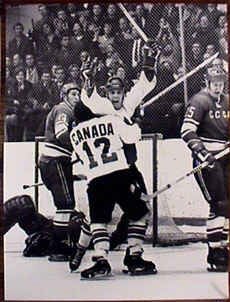
Almost any Canadian who is old enough can tell you exactly what he or she was doing on September 28, 1972, when Paul Henderson scored the 6-5 goal at 19:26 of the final period. For a moment, our world stood still, and then as the red light flickered behind Vladislav Tretiak, our hearts filled with joy, and relief.


As Foster Hewitt's ghostly words described "the goal heard around the world" millions of Canadians danced and hugged in a scene that was reminiscent of the celebrations at the end of World War II. Never has a single sporting moment meant so much to so many Canadians a sense of unparalleled nationalism.

Paul Henderson's goal sealed a remarkable comeback victory over a Soviet squad that had pushed Canada to the brink of defeat. Of course, none of this was supposed to happen. Team Canada was composed of the NHL's greatest stars, and were expected to easily defeat their communist counterparts. The success of the Soviets stunned Canadians, who had always unquestioningly believed in their country's hockey supremacy.

Team Canada restored the faith of fans by fighting back to win the final 3 games of the series, all on game winning goals by Paul Henderson. Henderson was a talented but unspectacular left winger who was the unlikeliest of heroes. Unlikely heroes have come to define Canadian hockey.

"I found myself with the puck in front of the net," remembers Henderson. "Tretiak made one stop and the puck came right back to me. There was room under him, so I poked the puck through."

"When I saw it go in, I just went bonkers." Millions of thrilled and extremely relieved Canadians went bonkers as well.

Forty years later, Canadians are still going bonkers about the series. Russians too have equally fond although often different memories about the clash at the top of the hockey world four decades ago.


September 27, 2013

Great Moments In Hockey History: Soviet Shocker At Game One Of 1972 Summit Series


It was supposed to be a cake walk for Canada. The Soviet amateurs would be crushed by Canada's top professionals. Oh, we'll show them just how good Canadian hockey really is. Sure, they could beat our amateur teams that were made up of mill workers and car salesmen, but this was going to be different.

Everything was going according to the script when Canada scored on the first scoring chance of the game just 30 seconds into the action. Phil Esposito, who seconds earlier enthusiastically won the ceremonial faceoff, potted a Frank Mahovlich rebound past a flopping Russian goalie named Vladislav Tretiak. 
By the 6:32 mark Canada upped the score to 2-0 when Paul Henderson wired a hard, but seemingly harmless shot to Tretiak's far side. Tretiak looked awkward as he feebly attempted to knock down the puck. 

The predicted rout was on. The party was on. 

"When I got on the ice," remembered Rod Gilbert in Scott Morrison's excellent book The Days Canada Stood Still, "it was already 2-0. Before I played my first shift it was 2-0, so I'm sitting on the bench saying, 'Let me on. Let me score my goals.' I figured it was going to be 15, 17-0, and I wanted to score a few goals." 

Gilbert's thoughts at that point were the common thoughts of almost every Canadian watching the game, and certainly of all the players playing in it. It was a feeling that Canadians not only shared during those opening minutes, but during the entire training camp and since the day the tournament was announced. For that matter, Canadians felt that confident about their hockey dominance ever since the Soviets arrived on the international hockey scene in the 1950s. 

Those thoughts were abolished forever before the night was over. 

 Full Story and Box Score @ 1972 Summit Series.com

Also See: 

September 28, 2012

1972 Summit Series: Game 8: Henderson Has Scored For Canada


Description: C:\Users\Joe Pelletier\Documents\Hockey -International\1972 Summit Series.com\photos\scoreboardfront.jpg

Almost any Canadian who is old enough can tell you exactly what he or she was doing on September 28, 1972, when Paul Henderson scored the 6-5 goal at 19:26 of the final period. For a moment, our world stood still, and then as the red light flickered behind Vladislav Tretiak, our hearts filled with joy, and relief.


As Foster Hewitt's ghostly words described "the goal heard around the world" millions of Canadians danced and hugged in a scene that was reminiscent of the celebrations at the end of World War II. Never has a single sporting moment meant so much to so many Canadians a sense of unparalleled nationalism.

Paul Henderson's goal sealed a remarkable comeback victory over a Soviet squad that had pushed Canada to the brink of defeat. Of course, none of this was supposed to happen. Team Canada was composed of the NHL's greatest stars, and were expected to easily defeat their communist counterparts. The success of the Soviets stunned Canadians, who had always unquestioningly believed in their country's hockey supremacy.

Team Canada restored the faith of fans by fighting back to win the final 3 games of the series, all on game winning goals by Paul Henderson. Henderson was a talented but unspectacular left winger who was the unlikeliest of heroes. Unlikely heroes have come to define Canadian hockey.

"I found myself with the puck in front of the net," remembers Henderson. "Tretiak made one stop and the puck came right back to me. There was room under him, so I poked the puck through."

"When I saw it go in, I just went bonkers." Millions of thrilled and extremely relieved Canadians went bonkers as well.

Forty years later, Canadians are still going bonkers about the series. Russians too have equally fond although often different memories about the clash at the top of the hockey world four decades ago.


September 27, 2012

The Two Faces Of The 1972 Summit Series


Guy Lapointe once said “Who says nothing lasts forever? This series will.”

The series Lapointe refers to is, of course, the 1972 Summit Series. Anyone who witnessed it first hand could not possibly forget.

Lapointe should know. He played against the Soviets in the epic showdown back in 1972. The Hockey Hall of Famer also played against them in the inaugural Canada Cup tournament in 1976. He’s seen all of the great Canadian hockey moments since then. Gretzky to Lemieux in 1987. Canada’s first Olympic gold medal in 50 years in 2002. And Sidney Crosby’s golden goal on home ice in 2010.

When asked if Crosby’s Olympic clinching goal in Vancouver would one day surpass Paul Henderson’s heroics in terms of national significance, Lapointe said “Nothing will ever beat ’72 in terms of importance. But Crosby’s goal may become more celebrated over the coming years. More and more there are more people in Canada now that were not around in 1972. It was a different time.”

Like most things the 1972 Summit Series is eventually destined to be mothballed into history rather than kept in public mystique. But that time may be a long ways off yet. It seems there are two groups of people keeping it very much alive and pertinent. Those who were there to witness, and those who were born afterwards and have grown up under it’s undeniable influence.

The amazing thing is that with the passage of time, both segments of the population have actually made the series grow in stature to the point where it overshadows reality.

“Henderson Scores For Canada!”

Almost any Canadian who is old enough can tell you exactly what he or she was doing on September 28, 1972, when Paul Henderson scored the 6-5 goal at 19:26 of the final period. For a moment, our world stood still, and then as the red light flickered behind Vladislav Tretiak, our hearts filled with joy, and relief.

"Here's a shot. Henderson makes a wild stab for it and falls," Foster Hewitt breathlessly described. "Here's another shot. Right in front. They Score!! Henderson has scored for Canada!"

As Foster Hewitt's ghostly words described "the goal heard around the world" millions of Canadians danced and hugged in a scene that was reminiscent of the celebrations at the end of World War II. Never has a single sporting moment meant so much to so many Canadians a sense of unparalleled nationalism.

Paul Henderson's goal sealed a remarkable comeback victory over a Soviet squad that had pushed Canada to the brink of defeat. Of course, none of this was supposed to happen. Team Canada was composed of the NHL's greatest stars, and were expected to easily defeat their communist counterparts. The success of the Soviets stunned Canadians, who had always unquestioningly believed in their country's hockey supremacy.

Team Canada restored the faith of fans by fighting back to win the final 3 games of the series, all on game winning goals by Paul Henderson. Henderson was a talented but unspectacular left winger who was the unlikeliest of heroes. Unlikely heroes have come to define Canadian hockey.

"I found myself with the puck in front of the net," remembers Henderson. "Tretiak made one stop and the puck came right back to me. There was room under him, so I poked the puck through."

"When I saw it go in, I just went bonkers." Millions of thrilled and extremely relieved Canadians went bonkers as well.

Overblown Myth Becomes Reality

Forty years later, Canadians are still going bonkers about the series. In fact, if anything, the series has inexplicably become bigger than it ever was.

Is it baby boomer nostalgia? In part, yes. History is often over sold by the victorious. Be it war battles, political wins or hockey games, we often over play the significance of such signature moments.

Or is it due to the generations of Canadians that have followed. They have grown up under the undying presence of 1972, and in their struggle to truly understand it they have inadvertently made it bigger than it ever was.

For those who lived through it, the 1972 Summit Series was an important piece of the Canadian fabric. But for those of who were born later - who grew up knowing the narrative but never truly understanding why these 28 days in September 1972 came to occupy such a privileged place in Canadian history - we experience the Summit Series somewhat differently.

You can read all you want about how this was Canada’s Cold War and how we defeated Communism. Or about how this series unified our own country in the height of the Quebec separatist movement.  You can even focus on how the hockey world was changed forever that September. But for those of us born too late, we can never truly understand what we missed.

It was such a foreign time. Much of the off ice drama that made the series so unforgettable is impossible to recreate. No history book or documentary can truly recreate what it was like to actually be a part of that moment in time.

The on ice action of course is now easy to re-live, thanks to DVD releases. Baby Boomers may enjoy re-watching all the action, but my generation finds even that impossible to watch now.

I actually tried to watch the DVDs a few times, but I quickly realized there was no way watching the games could come close to matching my expectation. We grew up with the Summit Series’ legacy - the unmatchable drama, the overwhelming nostalgia, the cultural importance, the national pride. But if you were not actually there to experience it in the first place, so much of the experience is mythical. To go back and watch it for the first time you quickly realize there is no way the grainy video could possibly live up to the legend this series has become. The heroes would deteriorate to just ordinary. The storylines would become anti-climatic. The emotion would all but be removed. Thanks to all the children - including myself - that have recreated Henderson’s goal a million times, there’s just no way the real thing could live up to the hype and euphoria that the legend has become after all these years.

For the generation born after 1972, the overblown legend of the 1972 Summit Series is our common experience. And we like it that way. We want to forever keep it that way. To watch the games now would tarnish our image of one of the most important events in Canadian history. Watching the games now would only disappoint.

The reality is the 1972 Summit Series has become an overblown myth larger than the actual event. And we never want to change that.

Summit Series Heroes: Phil Esposito


While Paul Henderson has been forever immortalized for his series winning heroics, Phil Esposito's effort in the tournament was equally as memorable. In fact, almost every member of Team Canada would be quick to point out that Espo - their undisputed leader - was the real hero of the series.

Right from the get-go, Phil was the leader of this team. He had a commanding stature and he oozed charisma. Players were quick to literally follow him in training camp and away from the rink. When his team struggled out of the gate, he fired them up, and wouldn't accept losing as an option. In fact, he never once felt Canada would lose, not even after falling behind 3-1-1 after the first game in Russia.

No one was more intense than Espo. In the ceremonial puck drop before game one, he vigorously won the usually friendly draw. Then just 30 seconds into the game he scored and celebrated emphatically.

The Russians soon proved that they would be no pushover, and in fact dominated the rest of game one, winning easily in Canada's cathedral of hockey - the Montreal Forum.

The humiliating defeat in game one seemed easy to take compared to the game 4 loss. In the final game played in Canada, Vancouver fans loudly booed Team Canada off of the ice. That would be Team Canada's lingering reminder of their lack of success as they headed to Russia.

But Espo would have none of that. He went on national television following the game and, with his heart and the Maple Leaf on his sleeve, he spoke his mind.

"To the people across Canada, we tried. We gave it our best. To the people who booed us, geez, all of us guys are really disheartened. We're disillusioned and disappointed. We cannot believe the bad press we've got, the booing we've got in our own building.

"I'm completely disappointed. I cannot believe it. Every one of us guys - 35 guys - we came out because we love our country. Not for any other reason. We came because we love Canada," he ranted off the top of his head.

Team Canada rallied around perhaps the most famous speech in Canadian history (yes, perhaps even more important than any political speech ever offered).

In fact, it was until after the speech Phil himself realized the battle Team Canada was in - a battle he termed "a war." As he left the post game 4 interview a heckler in the crowd continued to shout insults at him.

"I was so mad I felt like ramming my stick right down his throat," said Espo. "That's when I realized we were in a war, man. This isn't a game. This is a war and we'd better get ourselves together."

Team Canada headed to Russia, and Russian fans were quickly introduced to the charisma of Esposito. During the player introductions Phil stepped on a stem of a rose that was handed out to the players moments earlier. The big Italian fell flat on his butt. The arena erupted in laughter which turned into cheers as Espo got up and blew a kiss into the crowd and took a bow. Phil insists he was directing the kiss towards Soviet dictator Leonid Brezhnev, and that Brezhnev was not impressed.

Canada unthinkably blew a three goal lead in that first game in Moscow. That forced them to win all the remaining games. Thanks to Esposito's leadership and incredible play and Henderson's timely goal scoring, Canada was able to save face and win the tournament.

Espo led the tournament and scoring and tied for the goal scoring lead. He was as charismatic as the Soviets were stone-faced, which was symbolic of the sharp differences in the two societies. He played the tournament as is if he was possessed. He scored 30 seconds into the first game, and assisted on Paul Henderson's "goal heard around the world" with just 34 seconds left in game 8. Twice he was named the MVP of a game, and was instrumental in the game 8 victory, scoring twice and assisting on two others.

Paul Henderson as said that seemingly everyday of his life someone thanks him for scoring the dramatic goal in Moscow. Thank you too, Phil Esposito.

Summit Series Heroes: Valeri Kharlamov

Russia and the former Soviet Union have an incredibly rich hockey history only bettered by that of Canada. But who is the greatest Russian ever?

It's a question that is hard to answer because of the Cold War and the communists Iron Curtain politics. While many of today's fans will claim Sergei Fedorov or Pavel Bure or maybe Alexander Ovechkin is the greatest ever, it is almost impossible to determine Russia's greatest player from a Canadian's vantage point.

While the top Russian and eastern European stars are now allowed to come to North America and pursue a career in the NHL, this was not always so. Not until the late 1980's were the top older players given permission to leave. Prior to that point the only time we saw the Russians was in major tournaments such as the Canada Cup and the Olympics. What we did get to see of them left us in awe of the immense skill and team work.

While we have had a chance to watch such as Soviet superstars like Igor Larionov, Sergei Makarov and Viacheslav Fetisov, their best years were all behind the Iron Curtain. Those three get much consideration when discussing the topic of the greatest Russian players. Vladislav Tretiak of course also gets high rankings. However very arguably the greatest Russian player was Valeri Kharlamov, and we were almost completely robbed of enjoying his immense package of skills.

Valeri Kharlamov played during the 1970's prior to the arrival of Larionov and Makarov and co. His skating was unequaled and his passing and shooting was simply uncanny. He perhaps had the greatest arsenal of skill of any player ever, maybe even more so than Gretzky or Lemieux, but we never had the chance to really determine that. One European hockey expert described Kharlamov as a combination of Mike Bossy and Pavel Bure.

Read the full Valeri Kharlamov biography, and watch the video below:

September 26, 2012

1972 Summit Series: Game 7: Canada Forces Decisive Game 8

Game 6 was Canada's first victory since Game 2. This sparked an outpouring of excitement back home, as some 50,000 rejuvenated fans sent telegrams and best wishes to the team. This helped motivate Team Canada, who were all but alone in the powerful, undemocratic country.

Somehow the victory in Game 6 provided a great sense of confidence in the team. No matter how unlikely it may have seemed to an outsider, the team truly believed that they would win Game 7, and then Game 8.

Russia would have to play the game without their flashiest superstar in Valeri Kharlamov, who was sitting out this game with a badly bruised ankle thanks to the dastardly Bobby Clarke in Game 6. At the urging of Team Canada co-coach John Ferguson, Clarke wielded his stick in axe like fashion to chop down the flashy star. Clarke would later admit he had every intention of breaking the ankle he was aiming for.

Canada got off to a strong start in what might have been the best played game of the series. At just 4:09 of the game Phil Esposito opened the scoring thanks to a Ron Ellis centering pass.

Six minutes later the Soviets tied it up. Alexander Yakushev took advantage of a stumbling Brad Park to break in alone on Tony Esposito, slipping the puck between the goaltender's pads.

Park was victimized again for the 2-1 goal late in the period. While killing a penalty the puck bounced off of Park's skate directly to Vladimir Petrov's stick. Petrov easily converted.

Before the period was over Phil Esposito somehow managed to get the puck through a maze of players in front of the Soviet net and past the screened Vladislav Tretiak.

Goaltending was the story of the second period, particularly by Tony Esposito. Russia outshot Canada 13-7 in the frame, but no one was able to beat either puck stopper.

The tie was finally broken early in the third period when Rod Gilbert emerged from behind the net to stuff a backhand shot behind Tretiak.

The lead would be short lived as Yakushev scored his second of the game to tie the score at 3. Those Soviet teams were so amazing. Whenever the opposition thought they finally got a break against them, the Russians would seemingly always respond quickly and emphatically.

After the tying goal Russia seemed to put their offensive attack into a higher gear, but Tony Esposito was up to the task. He made half a dozen spectacular saves. However the Soviet momentum soon subsided, and the teams played tight, defensive hockey for the rest of the game. Neither team wanted to make a mistake.

At 16:26 of that final period, one of the most disturbing scenes in hockey history occurred. Soviet captain Boris Mikhailov and Canadian defenseman Gary Bergman collided along the side boards and began to push and shove. That's when the overmatched Mikhailov committed hockey's cardinal sin and used his skates as a weapon. He kicked at Bergman's shins repeatedly.

Bergman, who was cut but not seriously injured on the play, responded by ramming Mikhailov's head into the chicken wire that was used in Luzhniki Ice Palace instead of Plexiglas.

Full Story and Box Score

Summit Series Heroes: Ken Dryden


Ken Dryden was the top goalie of the 1970s. The highly intellectual Dryden appeared as if from nowhere in 1971 just in time to magically carry the Montreal Canadiens to the Stanley Cup - the first of 6 championships in 8 years in the National Hockey League. 258 NHL wins vs. only 57 losses and 5 Vezina trophy wins ensured his status as the best goalie of that decade and perhaps of all time.

However Dryden seemed to struggle against international competition, namely the Soviets. Phil Esposito once called a Ken Dryden a "damn octopus" because of his hulking size and quick arms and legs. For much of the series Dryden looked like a fish on land. He was clearly outplayed by Tretiak and at times his partner Tony Esposito.

Dryden had the unfortunate task of playing game one against the Soviets. His goaltending style was to cut down the angles by challenging the shooter and making the most of his immense size. But the Soviets used their cute offense consisting of sudden criss-crossing passes and shifty movement to make Dryden move around and lose his angles, and thus make him look silly at times. Backup Tony Esposito benefited from his bird's eye view on the bench to notice this and he was able to make adjustments to his game when he got the call in games 2 and 3, and stayed further back in his net and avoided challenging the shooter.

"I have been very fortunate to have played on six Stanley Cup winning teams in Montreal," wrote Dryden in Brian McFarlane's book Team Canada 1972: Where Are They Now. "But nothing in hockey ever brought me so low or took me so high. And nothing meant so much."

In an interview with the Globe and Mail in 1997, the always philosophical Dryden looked back upon the series saying that "a feeling comes before a thought comes. The feeling is a mixture of pain, satisfaction and mostly relief. And in retrospect, a sense of gratitude of having had that as an experience."

Although he is one of the NHL's all time greats, Dryden is also known as a best selling author. His book "The Game" is a legendary hockey book, but it was not his first published effort. Face-Off At The Summit - a 1973 book published by Little Brown - is an interesting look at the series through the eyes of one of the key competitors.

Summit Series Heroes: Boris Mikhailov


Boris Mikhailov is one of the most famed hockey players ever to come out of the former Soviet Union. From 1966 until 1981 he was a player of extraordinary magnitude and continues to be a force in Russian hockey today.

Mikhailov, famous for wearing the dreaded #13, combined with Valeri Kharlamov and Vladimir Petrov to form perhaps the greatest Russian unit of all time. This is supported by the trio's play in the 1973 World Championships when they finished 1-2-3 in the scoring race as the trio average just under nine points a game! In 15 World and Olympic Championship tournaments, they scored a combined 275 goals and 537 points!!

#13 personally scored 108 of those goals in the 120 games. He also added 77 assists and 60 penalty minutes.

His long list of accomplishments in International Hockey include: 
During Soviet League play, he played in 572 games scoring a record 427 goals along with 224 assists for a record 651 points. The 8-time Russian All Star led the league in scoring three times and was named MVP twice.

* 2 Olympic Gold Medals (1972 & 1976)
* 8 World Championships (1969-71, 1973-75, 1978-79) (voted top forward in 73 and 79)
* 9 Izvestija Championships
* 10 European Cups

Mikhailov was surprisingly "Canadian" in his approach to hockey. The Soviets prided themselves on being the opposite of North American hockey, yet the ruthless Mikhailov is remembered as a guy who loved to mix it up and go to the corners, digging for loose pucks. He had a knack for scoring important and clinching goals, more often than not they were by banging for loose pucks and scoring "garbage goals."


Read the full Boris Mikhailov biography

September 25, 2012

Summit Series Heroes: Paul Henderson


Paul Henderson needs no introduction. He may never be a Hall of Famer, but he has achieved a state of hockey status reserved for the rare likes of Gretzky and Richard.

While representing the Toronto Maple Leafs as a member of Team Canada 1972, the left winger had the tournament of his life. He scored the most famous goal in hockey history when he put the puck behind Soviet goalie Vladislav Tretiak with just 34 seconds left in the final game to give Canada a victory in the unforgettable 1972 Summit Series. Henderson was a dominant force in the series, scoring the game winning goals in each of the final 3 games as Canada came from behind to claim victory 4-3-1. He will be forever immortalized in hockey history as he scored on what is arguably the greatest hockey moment ever.

Henderson was actually one of the last players to make the team. He had a terrific training camp along with Bobby Clarke and Ron Ellis. All three were on the bubble as to whether or not they'd make the team or not, but they played extremely well together. They were Canada's best threesome, and the only line that was kept together throughout the series.

All three were incredible. Clarke was instrumental with his defensive play and his crisp playmaking, which in particular helped Henderson. Ellis did a masterful job of shutting down the flashy Valeri Kharlamov and was also used against the big Alexander Yakushev.

And then there was Henderson. Henderson was on fire throughout the entire series. He tied with Phil Esposito and Alexander Yakushev for the goal scoring lead with 7. He was especially hot in Moscow - he scored twice in game 5 and scored the game winners in game 6 and game 7.

The game 7 goal was spectacular. With less than three minutes left to play, Henderson was sprung lose thanks to a nice pass from Serge Savard. Henderson was in alone on two Soviet defenseman - normally an impossible scoring chance. Going in alone on two Russian defenders, he crossed so that the two defensemen were forced to cross positions. Henderson slid the puck through the defenseman's legs and went around. Instead of playing the man, defenseman Evgeny Tsygankov tried to play the puck. He failed to stop the puck and Henderson was in alone. He scored just under the cross bar while falling down, as the defenders tackled him.

And of course there is the most famous goal in hockey history: Henderson's game winner in game eight.

"In the final seconds of that game, I stood up at the bench and called Pete Mahovlich off the ice. I'd never done such a thing before," wrote Henderson in Brian McFarlane's book Team Canada 1972: Where Are They Now?, and undoubtedly told over a million times elsewhere.

"I jumped on the and rushed straight for their net. I had this strange feeling that I could score the winning goal. I had a great chance just before I scored, but Cournoyer's pass went behind me. Then I was tripped up and crashed into the boards behind the net. I leaped up and moved in front, just in time to see Esposito take a shot at Tretiak from inside the face-off circle. The rebound came right to my stick and I tried to slide the puck past Tretiak. Damn! He got a piece of it. But a second rebound came right to me. This time I flipped the puck over him and into the net."

Although he couldn't have comprehended it at that moment in time, he had just become an immortal in the hockey world.

Summit Series Heroes: Vladislav Tretiak

Vladislav Tretiak was never given a chance to play in the NHL, but he captured the hearts of many North American fans when he helped the Soviets push Canada to a gigantic eight game battle in the 1972 Summit Series.

Tretiak was the hero of the tournament. Not only was he a hero on the Russian front, but he became a hero on the Canadian side as well. In fact no Russian player has the respect of Canadians more so than Tretiak.

Tretiak was an unheard of 20 year old at the beginning of September 1972. He was dismissed as the weakest link of the Soviet "amateurs" due largely to a single scouting trip by Team Canada. Scouts Bob Davidson and John McLellan spent just 4 days in Russia and saw Tretiak in just one intra-squad contest. Tretiak allowed 8 goals and the Canadians chuckled at the man that was supposed to play in nets against Team Canada just a couple of weeks later.

The scouts made a huge mistake by only watching the one game. As it turned out Tretiak had spent much of the previous night partying as he was getting married soon after. As a result he played horribly before Team Canada's watchful eyes in the stands.

In the end, Tretiak chuckled the hardest. "Maybe it was a trick," hinted Tretiak years later, referring to the Russian's mysterious ways of playing possum with their sporting opponents.


Full Vladislav Tretiak biography

September 24, 2012

1972 Summit Series: Game 6: The Slash

After the Soviet come-from-behind victory in Game 5 to take a commanding 3-1-1 series lead, you would have expected Team Canada to be demoralized and dejected and Russia would have gone for the kill.

Things didn't exactly unfold that way, however. Canada kept positive and felt that they could still win, while Russia, admittedly in hindsight, became overconfident and ultimately allowed the Canadians back into the series.

Canada had felt like they were finally coming into form. Remember this was the beginning of the professionals' seasons, and unlike the Soviets who trained almost year round, the Canadians were just coming into game shape. And remember also that while the Russians knew all about the Canadian game, the Canadian knowledge of the Soviet strategy was nonexistent entering the series. Now, after five games, Canada felt they were prepared to play the Soviets.

The first period wasn't dominated by Esposito or Mahovlich, or by Yakushev or Kharlamov, but rather by two guys named Kompalla and Bata. They were the two referees from West Germany that were so brutally bad that it was charged that they were blatantly biased against the Canadian players. Canadian players were repeatedly sent to the penalty box for questionable and phantom penalties. Phantom offsides were being called as well. Somehow the Soviets were rarely being called for penalties, though. You can chalk it up to cultural differences in the differing styles of hockey. By the end of the game, the penalty minutes were 31 for Canada, just four for Russia.

Fortunately Team Canada's penalty killing was in top shape for this game, as the Soviets possessed a lethal power play.

Full Story and Box Score

Summit Series Heroes: Bobby Clarke


Twenty two year old Bobby Clarke launched his career into the superstar stratosphere in these 8 games in September of 1972. Which may have been a surprise to some, as he was the last player to make the team.

The Philadelphia Flyer's infamous yet voracious leader made the team loaded with center icemen thanks largely to a great gelling with linemates Paul Henderson and Ron Ellis. Right from early on in the series, this surprising trio emerged as Canada's best line. Clarke is quick to credit the trio's status as borderline players as to whether or not they would make the team as their biggest advantage, as they took the training and preparations more seriously than many of the superstars who were all but guaranteed a spot on Team Canada.

Clarke earned the respect of many in the series for his determined play, his near-flawless faceoff ability and his solid two-way play.

"There were guys on Team Canada who took their game to new heights in that series. A perfect example would be Bobby Clarke," stated Wayne Cashman.

Paul Henderson, who benefited greatly from playing with Clarke, admired him greatly.

"Bobby Clarke turned out to be one of the most dedicated hockey players that ever played the game. The best thing that could have happened to Ronnie (linemate Ron Ellis) and me was to get this young kid making plays for us. He was terrific!" Henderson enthusiastically stated.

The "Flin Flon Bomber" also earned the despise of many  as he is of course remembered for a vicious two handed slash on Soviet superstar Valeri Kharlamov's sore ankle, which caused him to miss the final game. Many have chastised Clarke for his dirty actions. It is a bit of a trademark image for Clarke, who was known as a gritty but sometimes dirty player who would do whatever it took for his team to win.

Clarke was once asked by famous hockey journalist Dick Beddoes about the slash. Clarke, in typical fashion, downplayed the "tap on his sore ankle" as a part of hockey. "If I hadn't learned to to lay on a two-hander once in a while, I'd never have left Flin Flon."

"Team Canada '72 is right at the very top of my hockey life. I always considered winning the Stanley Cup more important, but certainly, they're close to being equal," Clarke stated in Brian McFarlane's excellent book: Team Canada 1972 Where Are They Now?

Summit Series Heroes: Valeri Vasiliev


Considered by many to be the toughest and most physical defenseman in Russian hockey history, Valeri Vasiliev was a punishing hitter who loved the physical play. Valeri reminded people of Hall of Famer Tim Horton.

He didn't have the offensive flair like Alexei Kasatonov or Vyacheslav Fetisov but was better defensively. Opponents hated to play against him because it could be painful. As a surprise to many opponents Valeri was only 6'0" and 190 Ibs but played like a much bigger player. He put several opponents on the injury list during his career.

Valeri was born on August 3, 1949 in Bora, just outside of Moscow. He began playing organized hockey as a 12 year old for Torpedo Gorky. He then went on to play league hockey his entire career for Dynamo Moscow between 1967-84. In one year he was actually demoted to the third division for disciplinary reasons following an incident on the national team.

Long time Soviet observers talk about a young and over rambunctious Vasiliev who enjoyed the physical game far too much for the Soviet theory of hockey. It was veteran defenseman Vitaly Davydov who took the short-tempered Vasiliev under his wing and turned him into not just a refined tactician, but one of the greatest defensemen in the world.

Valeri was a born leader and was a longtime captain of the national team. He was a two time Olympic Gold medalist (1972 and 1976). He was a eight time World Champion, being voted the best defenseman three times (1973, 1977 and 19 79) and being named to 5 WC All-Star teams. Valeri represented his country 284 times and scored 44 goals. He was a member of the "super five" together with his partner on the blue line Vladimir Lutchenko and behind the troika of Kharlamov-Petrov-Mikhailov, the predecessors of the Makarov-Larionov-Krutov unit with Kasatonov and Fetisov.

Yet he never experienced a Russian league championship. He was one of very few players on the Soviet national team who never played for the Red Army team CSKA. The Red Army team dominated the home league because it was essentially comprised of the national team. Only a few players like Vasiliev were brought in to join those players for the national team. Valeri played a total of 617 games and scored 71 goals. His 617 games is still a league record.

Because of his physical style he loved to play against NHL opposition. He thrived in that environment, and because of that the Russian Strongman was one early Russian player who likely would have excelled in the NHL.

He played in the 1972 Summit Series as well as the 1979 Challenge Cup. Valeri had a big part in neutralizing Wayne Gretzky, Guy Lafleur, Marcel Dionne and the other Canadian superstars in the 1981 Canada Cup final. That was the only year the Soviets won the Canada Cup. Vasliev, as team captain, accepted the famous trophy.

Vasiliev was also a very efficient and speedy skater, despite looking quite awkward. He had an unusual way of propelling himself down the ice. He did not lift his skates off the ice while rapidly accelerating. This allowed him incredible stability. He was almost impossible to knock him off his feet.

After his playing career was over Valeri coached the juniors of Dynamo Moscow (1984-89). He then went over to Germany where he coached EC Ratingen (1990) and Bad Reichenhall (1991). In 1996-97 he was the assistant coach for Spartak Moscow. In 1998 he was inducted into the IIHF Hall of Fame.

Valeri has never been replaced on the national team by someone who could match his physical play and toughness. It's an element that has been sorely missed on the Russian national team over the years.

September 23, 2012

Ken Dryden On His Return To Russia


The always eloquent Ken Dryden recently penned a beautiful guest article for The Globe and Mail about his return to Russia to celebrate the 1972 Summit Series 40th anniversary.

Interestingly, though 1972 is his "favourite hockey memory" he has had little desire to look back on it. 


I’ve never watched any of the movies or documentaries about Team Canada, or read any of the books. Now, 40 years after the series ended, my feelings are clear. While I was at Cornell, we won a national collegiate championship. In Montreal, we won six Stanley Cups. In most of those, I played a more important role than I did in the Summit Series of 1972, but, even if I wanted to, I couldn’t persuade my feelings otherwise.
The Summit Series is my favourite hockey memory. And I have too much of a stake in that memory to risk it on someone else’s version of the series, on seeing things again many years later with different eyes, and wondering if I got it right the first time. I’m not interested in wondering. I feel what I feel.
As always Dryden's commentary is brilliantly retrospective, making for an excellent read. 

Toronto Star's Coverage Of 1972 Summit Series 40th Anniversary

The Toronto Star has some excellent 1972 Summit Series coverage.

Damien Cox of the Toronto Star has an interesting piece about remembering the 1972 Summit Series in actuality compared to what it has become. The premise of the article is summed with the line "this notion that every Canadian family lived and died with every moment, every shot and every goal, of that ’72 Summit Series is, I think, somewhat exaggerated with time." Yet he also ends the article with "That goal, whether I saw it or not, is part of me. And always will be."

Paul Hunter has brilliantly placed a collection of quotes to completely retell the 1972 Summit Series story. There's some intimate stuff in there - such as Phil Esposito saying "That's as close I ever came to kissing a guy!

Dennis Gibbons, perhaps the leading Canadian authority on Soviet hockey, offers a special look back at the 9 Soviet stars who are no longer with us. That includes Valeri Kharlamov, of course, who died tragically in a car accident in 1981. He was only 33 years old.

Dan Ralph tells us Paul Henderson never tires of talking about the Summit Series. Of course, you can read much more from Henderson in his new book release The Goal Of My Life.

The Star also offers looks at Gretzky and Lemieux's magic at the 1987 Canada Cup and Sidney Crosby's Golden Goal at the 2010 Olympics.

The Toronto Star does offer a collection of original 1972 content including articles and photography in e-book form. They charge $4.99. By the way, the Montreal Gazette offers their own such offering, and it is completely free.

Backchecking With Paul Henderson


In The Hockey News Evan Boudreau recently caught up with Paul Henderson. He applauds Henderson for his biggest contribution in life - not scoring the Summit Series winning goal, but being a great role model for others as he struggles with his battle with leukemia.

In November 2009, Paul Henderson got the shock of his life. During a routine checkup, his doctor recommended an abdominal ultrasound – a seemingly harmless precaution. “I’ve always kept myself in good shape,” Henderson said. “They did an ultrasound on my abdomen to make sure everything was OK and I was full of gross tumors.”

At 66, Henderson was diagnosed with chronic lymphoid leukemia. It’s the most common form of leukemia, primarily found during similar routine checkups. The man whose three consecutive game-winners in the 1972 Summit Series fortified Canada’s comeback over the Soviet Union had entered the third period of life. “I was really shocked,” Henderson said. “They told me I might have a year, a year and a half when I was first diagnosed and I’m up to two years now.”

Two years, 20 books and one bible later, Henderson became more than just a volunteering professional. He became an Anglican. Now 68, his back pressed against a massage chair, feet resting on an exercise ball and a deadly disease accelerating his internal clock, Henderson can say he has “no annex or fear in my body whatsoever even though I’m full of cancer.”

While many view cancer as a progressive closing of all doors, Henderson sees only opportunity in life. On the 38th anniversary of his biggest goal, Henderson kicked off the 2010 Road Hockey to Conquer Cancer. “Anything cancer research is obviously near and dear to my heart,” he said. “I’m a hockey player and I have cancer. The two kind of go together. I’m not looking to be the poster boy for cancer, but anything that I can do.”

Here's the full story.

The Goal Heard Around The World: Cole, Lecavalier, Moreau, Ozerov, Provided Alternate Calls


It has been called "the goal heard around the world."


For most of us, Foster Hewitt's ghostly words are as much a part of the series as the goal itself. It is probably the most recognizable sound byte in Canadian history.

But not everyone was listening to Foster Hewitt when Henderson scored that goal.

Some people were listening to the radio broadcast of the game. CBC's Bob Cole, now known for his many 
years on Hockey Night In Canada, had his own call of Henderson's goal.

''Cournoyer steals it. A pass in front, Henderson... was upended as he tried to shoot it. Here's another shot. HENDERSON RIGHT IN. HE SCORES!    HENDERSON!    The team powers over the board. They're mobbing Henderson. They're hugging Henderson. And Kenny Dryden,. . .  I've never seen a goaltender do that (inaudible) from one end of the ice to the other, over 200 feet, all the way. And team officials are over the boards. Henderson has got to be the hero of the entire nation now...34 seconds left. They have a 6-5 lead. Can they hang on'?'
And others still might have been listening to the Rene Lecavalier's call on the French broadcast.

"Cournoyer qui s'avance. Oh, Henderson a perdu la passe! Il a fait une chute. Et devant le but. ET LE BUT DE HENDERSON! Avec 34 secondes encore!"

Or perhaps someone was travelling or working and had to listen to Jacques Moreau's call on CBC French radio.

Of course if you were a fan of the Soviets,  you heard a much different reaction undoubtedly. Unfortunately finding the text of Russian broadcaster Nikolai Ozerov's call of the goal is proving to be almost impossible.

If by any chance you know of Ozerov's words, I'd love to be able to share them with the rest of the world. In that unlikely case please contact me.