OVER 3000 HOCKEY LEGENDS PROFILED! SEARCH BY ALPHABETICAL LISTING

A B C D E F G H I J K L M N O P Q R S T UVW XYZ

July 31, 2015

Rob Schremp


Rob Schremp was once touted as one of the NHL’s most promising young players. He was a gifted playmaker and goal scorer who was well known for his magical hands. He was a highlight reel regular for his many trick shots he could pull in practice and shootouts, and for his emphatic celebrations afterward.

However, Schremp failed to translate his tremendous play in the junior ranks into a long and successful NHL career. This was largely because of his lack of foot speed and balance on his skates.

"He needs the strength base and the quickness. He's got to be strong enough to battle at a standstill with players because he's not going to outskate many players," said Craig MacTavish, the Oilers coach..

The bottom line seemed to be if Schremp could not to be a top line scoring star, he was not going to play in the NHL. He didn't have the size or strength or defensive game to play on lower lines.

In the 2004 NHL Entry Draft, Schremp was selected in the first round, 25th overall by the Edmonton Oilers.

Schremp was one of the most spectacular players to come out of the London Knights organization. In 2004-05 he scored 41 goals and 90 points in 62 games, then adding 13 goals and 29 points in 18 playoff games while leading the Knights to the OHL and Memorial Cup championships. He then upped his production to an amazing 57 goals and 145 points in just 145 games as the league's leading scorer. The confident/cocky Schremp would add another 47 points in 19 playoff games, but the Knights lost the OHL final.

For all his success at the junior level Schremp never found much offense at the NHL level, and never was a full time NHL player.

Over three years with the Oilers organization he would only play in 7 NHL games. They would lose him to the New York Islanders on the waiver wire in 2009.

The Islanders were a pretty weak team at that point, but Schremp continued to struggle to stay in the line up. He would play 44 and 45 games, respectively, in two seasons with the Islanders, putting up a reasonable 17 goals and 47 points, though he was sheltered defensively and used primarily as a power play specialist.

But with his lack of speed, size and defensive game, the New York Islanders gave up on Schremp, too. They put him on the waiver wire with the intent of demoting him to the minor leagues, but would end up losing him to the Atlanta Thrashers.

Schremp's stay in Atlanta was again brief. He finished the season playing in 18 games for the Thrashers, scoring just four points. He was not offered a contract at the end of the season.

Schremp took his game of tricks and skills on a well-travelled tour of Europe, playing, with some mixed results, in many countries.

To many fans, Rob Schremp will always be remembered for what he could have been rather than what he was. So why didn't his spectacular junior game translate into a NHL career?

It seems Schremp never was interested in evolving his game to doing what he needed to play at the NHL level.

"I want a fair chance. I want to be able to play my game. You can take instruction on how to learn play-systems and traps, but I just hope that my game can stay intact . . . (and I play) the kind of hockey I played with the Knights," said Schremp early in his career.

Yet according to Schremp's first year AHL coach Todd Richards, his junior game needed to be tweaked to make it as a pro.

"Right now, I think what he’s doing is he’s bringing his junior game. I don’t mean that in a negative way. There’s things he’s done his whole life that he’s been able to do. Now he’s playing against guys that are bigger, stronger, faster. Those plays aren’t there anymore."

Yet Schremp was never able to convince his coaches that he had indeed evolved, or that he could play any other role at the pro level. He may have had top end offensive talent, but the rest of his game was not at the level it needed to be.

Alex "Touch" Wood

Alex Wood, often mistaken as Alex Woods and affectionately known by his nickname "Touch," was a minor league all star goalie who got into one NHL game.

Wood was born in Scotland but raised in Saskatchewan. He joined the Regina Pats in 1928-29, just one year after the franchise won the Memorial Cup. He would only play one season in Regina/ Tje Calgary Canadians ended Regina's run that spring.

Wood would sign with the Chicago Black Hawks organization, though he would never play with the Hawks. He would be assigned to the minor leagues where he would extensively travel over a 13 year career (plus two more seasons of senior hockey). He found great success, too, as an all star and shutout king.

On January 31st, 1937 Alex Wood got his only chance in the National Hockey League. The New York Americans were in need of a goalie for their game against the visiting Montreal Maroons. Their regular goalie, Alfie Moore, was unable to play that night. They summoned Wood from the New Haven Eagles to travel to New York and play in the game.

Wood played very well, but ultimately lost the game 3-2 in overtime. Note that he is credited with playing 70 minutes in his only game. Back in those days over time was a full 10 minutes and not sudden death.

Frank Ingram

Frank Ingram was born in Craven, Saskatchewan. He first became famous as a hockey player when he travelled 40 kilometers south to Regina to play for the Regina Pats junior team in 1924. He, along with Johnny Gottselig, was a member of the Pats very first Memorial Cup championship in 1925. Ingram scored the overtime game winning goal on a rink long rush in game one against the Toronto Aura Lee.

Ingram was able to parlay that junior success to three seasons with the Chicago Blackhawks in the early 1930s. His best season was 1930-31 when he scored 17 goals in 43 games. He would total 24 goals and 40 points over his 101 NHL game career. He added eight more seasons in the minor leagues as a well travelled hockey player. He played with 15 teams in 8 different leagues!

One of his stops was three seasons - two as an all-star - with the Oklahoma City Warriors of the American Hockey Association. It was in Oklahoma City that he returned to live after hockey was done. He remained their until his passing in 1985. He was 79 years old.

Chuck Hamilton

When Kirkland Lake, Ontario's Chuck Hamilton played his first NHL game with the Montreal Canadiens in the 1961-62 season, he hoped many more games would follow.

It would take more than a decade before he played game number two.

Not that hockey was even Chuck's ultimate goal in life.

"Most of us set out just to be able to work," he told author Richard Buell in his book The Glory Of The Game: Hockey Heroes, History and Heritage From The Mile Of Gold. "I had promised my dad I wasn't going to be stuck working in the mines, and I had promised him I would get an education, and that's what I did."

While Hamilton graduated with his high school diploma, he was more famous locally for his athletic pursuits than his academic ones. He was a star both on the ice and on the football field.

The Chicago Blackhawks had zeroed in on Hamilton and tried to get him to sign the required "C Form" in the days before there was a NHL draft. But he refused to sign as he wanted to keep his options open for possibly attending a US college hockey program.

The Montreal Canadiens then invited him to play with their junior team the Peterborough Petes, playing under coaches like Teeder Kennedy and a young Scotty Bowman. He was billeted by Eddie and Marion Redmond. Their sons Mickey and Dick loved having a Petes hockey star in their house. One day they would go on to the NHL, too.

After graduating with the Petes Hall accepted a hockey scholarship at the University of Michigan though he withdrew early. He finally signed with the Montreal Canadiens organization so he could play with the Hull-Ottawa Canadiens farm team. That arrangement allowed Hall to complete a Bachelor's Degree in mathematics from Carleton University in Ottawa.

Meanwhile, on the ice the Canadiens converted Hamilton from a forward to a defenseman. He would play four seasons with Hull-Ottawa, getting called up to play with Montreal for that single game, before moving to Hershey to play with the AHL Bears for his eight seasons, winning a Calder Cup in 1970.

A nasty pre-season leg injury cost him the entire 1970-71 season but he ame back and played with the league champion Denver Spurs of the WHL the next season. He would spend one last season in Denver, getting called up to the NHL to play three games with the St. Louis Blues.

When he left the ice he did not go far as he found success by stepping behind the bench. He coached in the AHL through the 1970s, winning the AHL Coach of the Year in 1974-75.

Hamilton later became an account executive for an electronics firm near Hershey. He later sold General Electric products throughout the Midwest.

Hamilton retired, living in Collingwood, Ontario in the summer and Punta Gorda, Florida in the winters.

July 30, 2015

Gene Sobchuk


Dennis Sobchuk was one of the all time great players in Regina Pats history. He parlayed that into a lengthy pro career, most notably in the World Hockey Association with two brief stops in the National Hockey League.

But not a lot of people know his brother, Gene, also played in the NHL.

Gene, three years older than Dennis, graduated from the Pats in 1971, the same season Dennis first joined the Pats. Gene actually spent most of his junior career with the Weyburn Red Wings. He led the entire Saskatchewan Junior Hockey League in assists in 1969-70, with 36 in 36 games. That same season he led Weyburn to the Memorial Cup final where they lost to Gilbert Perreault's Montreal Junior Canadiens.

The New York Rangers drafted the 5'9" and 170lb left winger with the 109th overall pick in the 1971 NHL Draft. But it was a tough couple of years in the minor leagues, low-lighted by a collapsed lung and appendectomy in 1972-73

The following season he became property of the Vancouver Canucks. Sobchuk played his only NHL game with the Canucks on December 7th, 1973, against the Atlanta Flames. Sobchuk wore jersey number 21 but did not record a point.

That may have been Sobchuk's only NHL game, but he did play a season with in the World Hockey Association with the Cincinnati Stingers where he finally got to play with his brother Dennis. It was a good season in the WHA, as Gene won the Booster Club's "Mr. Hustle" award.

Sobchuk would continue playing in the minor until 1977 when a nasty wrist injury after crashing into the goal post.

Gene would return to his native Lang, Saskatchewan where he continued to play senior hockey while coaching and managing his old junior team in Weyburn. He also operated a farm.

Rod Norrish

Rod Norrish had a spectacular junior career in Saskatchewan. He turned that into a 21 games in the National Hockey League with the Minnesota North Stars.

Norrish played with the Regina Pats from 1969 through 1971. He scored an impressive 86 goals in 115 games.

His best season was in 1969-70 when he scored 37 goals in just 35 games. At the completion of the Pats junior season he was loaned out to the Weyburn Red Wings for their Memorial Cup push, scoring 21 points in 19 playoff games. However Weyburn would lose out to Gilbert Perreault's Montreal Junior Canadiens.

Weyburn had gotten to know Norrish all too well that season. On November 25th, 1969 he scored the opening goal against Weyburn just five seconds into the game!

And that wasn't even his best game of the season. Less than two weeks later, on December 7th, 1969 he scored three goals in just 20 seconds - bettering the NHL record famously set by Chicago's Bill Mosienko in 1952 by one second!

With that fine junior resume the Minnesota North Stars selected Rod Norrish 21st overall in the 1971 NHL draft.

Norrish's rookie pro season was a disaster. He broke his leg early in the season, causing him to miss half the season. He would finish the season with zero goals and only one assist in 39 games with the Cleveland Barons of the AHL.

Norrish rebounded with two solid AHL seasons that resulted in his first taste of NHL action in 1973-74.

Norrish even scored a goal in his very first NHL game, scoring the 1-1 tying goal at 12:15 of the first period against Rogie Vachon of the Los Angeles Kings. Norrish would play a total of 9 games with the North Stars that season, totalling two goals and three points.

Norrish would get another 12 game look with Minnesota in 1974-75, scoring another goal and two more assists, but he had a rough season in the minor leagues with the New Haven Nighthawks. He would score just nine times in 52 games.

That proved to be Norrish's last season in pro hockey. He would play a season of senior hockey in Spokane, Washington before he returned to his hometown of Strongfield, Saskatchewan and got into the trucking and farming.

July 29, 2015

Miracle On Ice Goalie Selling 1980 Olympic Memorabilia


Jim Craig, the unlikely goaltending hero for Team USA at the 1980 Olympic Winter Games in Lake Placid, is selling 19 items from his personal collection. He is hoping to raise $5.7 million.

The jersey he wore against the Soviets, the American flag he famous draped around himself and the Olympic gold medal are each appraised at $1 million by Lelands.com, the auction house selling Craig's items.

Craig is selling the items for the long term benefit of his family.

"For the past 35 years, these items have been at the Hockey Hall of Fame, the Boston sports museum, the New York sports museum, and I think we've done a good job showing them because this moment was so big that I truly believe everyone was a part of it," Craig told ESPN.com. "But after the 35th anniversary [this past February], and after our teammate Bobby Suter died, I thought it was important to be responsible with these pieces to grow and protect the legacy for my family."

Craig only briefly played in the NHL following the Olympic victory. His primary source of income over the years has been from working the motivational speeches tour.

Craig wants to find one buyer for all of the items.

Hockey Legend of the Day: Ted Lindsay


Dan Focht

The fastest rising star of the 1996 NHL draft was Dan Focht. He started his draft season as a mid round prospect, but rose all the way to the 11th overall pick.

And how could a scout not be intrigued. 6'6"and 225lbs. Very mobile for such a giant. He certainly was not shy to use his physical advantages, though he lacked a true mean streak. There was little offensive upside to Focht's games, but with general managers drooling about the next Derian Hatcher or Scott Stevens.

The Phoenix Coyotes, freshly relocated from Winnipeg, made him the first ever draft pick by the new team. He was selected ahead of Derek Morris, Dainus Zubrus, Marco Sturm, Daniel Briere, Corey Sarich and Matt Cullen, all of whom would play close to 1000 games or more in the NHL.

Coyotes manager selected the hulking Focht largely based on the Team Orr vs Team Cherry, a mid-season all star game of sorts for the top prospects. Focht was not even supposed to play, but was a last minute replacement for the injured Ric Jackman. Focht was so dominant on that nationally televised game that he was named as the game's MVP.

Focht's career trajectory did not continue on the same fast path. It would take him six years before he would ever play a NHL game. His stops included the AHL, ECHL and Finland.

In the 2001-02 season Focht finally appeared in a Coyotes uniform, playing in nine games.  He also got into what proved to be his only NHL playoff game, picking up his first assist.

In 2002-03 he returned to Phoenix for 10 games before being traded to Pittsburgh with Ramzi Abid and Guillaume Lefebvre for Jan Hrdina and Francois Leroux.

The move to Pittsburgh was a good move for Focht's career. He finished the year playing 12 more games. He also played the full 2003-04 season in Pittsburgh, scoring two goals and five points while averaging 17 minutes per game with the rebuilding Penguins.

Focht was a casualty of the 2004-05 lost lockout season. He signed AHL level contracts for two more seasons before retiring from the game at age 28.

Focht returned to his native Saskatchewan where he coaches youth hockey and is an avid outdoorsman.

Former NHLer Leo Reise Jr. Passes Away

I guess you can say Leo Reise Jr. was born into hockey.

The nine-year NHLer was born while his father Leo Sr. was playing in the 1920s with the Hamilton Tigers, New York Americans and New York Rangers. during his own eight-year NHL career. Leo Jr. followed in his footsteps in fine form and by doing so they became the first father and son tandem to play in the NHL.

After splitting his first two seasons between the Chicago Blackhawks and the minors, Leo Jr. joined the Detroit Red Wings in 1946-47. He played six seasons with the Wings where he worked as a fiercely proud journeyman in the shadows of the likes of Gordie Howe. Reise Jr. never really minded, as was part of two Stanley Cups championships.

Reise Jr.'s fellow defensemen included Black Jack Stewart, Marcel Pronovost, Red Kelly and Bill Quackenbush. Talk about a great blue line! But don't dismiss Reise Jr. as a spare part.

His third-period shorthanded goal in Game 7 of the 1949 semifinal against Montreal snapped a 1-1 tie and propelled the Wings to a 3-1 victory. That goal was reputed to be Reise vs the Canadiens, as Reise gathered the puck in his own zone and battled along the boards past all five Montreal skaters before driving a 40-foot shot past Canadiens goalie Bill Durnan.

"Leo Reise scored that goal that broke the tie because he absolutely refused to give up," Wings coach Tommy Ivan said. "He lost the puck twice and got it back because he kept fighting for it."

Then against Toronto in the 1950 semifinals, Reise whipped a backhand off the leg of Leafs defenseman Gus Mortson and behind goalie Turk Broda after 20:38 of overtime for a 2-1 victory. With the seventh game of the series scoreless and into the second OT session, Reise lifted a 35-foot backhander through a crowd past Broda and the Wings moved on to meet and beatt the New York Rangers in the final.

The first Stanley Cup championship in 1950 ranks as Reise Jr.'s career highlight.

"Well I think it has to be the year we won the Stanley Cup in '49-50 when I scored the two overtime goals against the Toronto Maple Leafs to eliminate them out of the semi-finals. It was a pretty rough series. I think those goals I scored in overtime were probably the highlights."

Reise definitely knew how to pick up his game in the playoffs. During his career, he averaged a goal every 18 games during regular-season play, but tallied once every six games in Stanley Cup competition.

Reise Jr. also counts playing in the six-team era as a true highlight. The rivalries were intense, even if Detroit often came out on top in those days.

"Well, we just had rivalries against … a couple years we only lost 11 hockey games. Eleven games one year and only 13 games the next year so we didn't mind playing against anybody. The toughest of all our games were against Toronto and the Canadiens. Richard was a fantastic hockey player. Very great competitor and he was tough to play against. We didn't have any particular team we were afraid of or anything like that. We could beat anybody at any given time. The last few series we only won in eight games. In '51-52 we won the series in eight games, so we were powers."

Reise Jr. mentioned a couple of other players he had great admiration for.

"From the standpoint of great hockey players, Jack Stewart was a fine, great defenceman. Guys like Milt Schmidt were great competitors that played with Boston. But these were great hockey players. You don't idolize them but you want to make sure you can emulate them really."

Reise then finished his career off by playing two more seasons with the New York Rangers. Over his nine NHL seasons, Leo Jr. scored 28 goals, 81 assists, and 109 points in 494 regular season games while adding eight goals and 13 points in 52 playoff contests.

He got out of hockey and returned to Hamilton, operating a plumbing wholesale house which grew to 11 outlets across Ontario. He would later start up a plastic company that he ran for 17 years before he sold his shares.

You get the feeling Reise Jr. is as proud of his non-hockey life as he is of his hockey life, which is the way it should be. Though he was born into hockey and it played a big part of the first half of his life, he moved on and had many interests.

"Well, hockey was a big part of my life for only for nine years. After that, I had business to attend to. And when I got out, I went to McMaster and I got my degree in science there and I got out of that and I went back to accounting which I started when I went into the service and the navy. So I got my Certified General Accountant designation after that. I was busy studying and raising kids and all that sort of stuff. Very busy man."

Leo Reise Jr. was a hard worker, on and off the ice.

Enver Lisin


An explosive skater with good hands and a powerful shot, Enver Lisin was most effective when using his speed to drive to the net. He was a solid playmaker when he chose to be, but he tended to be a bit of individualistic player, overhandling the puck on solo dishes a little too often for any coach's likes.

The Phoenix Coyotes selected Enver Lisin 50th overall in 2004. He was a junior linemate of Alexander Ovechkin. Twice Lisin would win silver medals at the World Juniors.

The following season he joined Ak Bars Kazan for his rookie season as a pro. He thrived along side NHL talent that headed to Russia in droves due to the NHL lockout. Ilya Kovalchuk, Vincent Lecavalier and Alex Kovalev were among his teammates. Lisin was runner up as the top rookie in the Russian Super League.

Lisin remained behind with Kazan in 2005-06 once all the NHLers left. Surprisingly he had a setback season. He ended up playing on the fourth line with a revolving door of linemates and never found his stride. Still, Kazan won the league championship.

Lisin headed over to North America in the 2006-07 season but found himself mostly apprenticing in the American Hockey League for the first two seasons. That was once he agreed to report, however.

Lisin started the 2006-07 season with the Coyotes American Hockey League affiliate the San Antonio Rampage, scoring two goals in two games. He was quickly recalled to the Phoenix where he played 17 games at the NHL level but only contributed one goal and one assist. As a result the Coyotes tried to send him back down to the AHL, however he refused and got on a plane back to Russia. He finished off the season with six goals and two assists in 20 games with Ak Bars Kazan in the Russian Superleague.

For the 2007-08 season the Coyotes management convinced him to return to North America and he had a successful developmental season spending the majority of his time at the AHL level. He had 35 points in 58 AHL games and six points in 13 NHL games during that season.

"I liken him a little to Jiri Hudler when he came to Grand Rapids (AHL)," said Greg Ireland, San Antonio's head coach. "He skates better than Hudler. Hudler may have a little more touch around the net, but Lisin is good. He's willing to take the puck to the net, he has a real good touch and he has a real good release."

But, as Ireland points out, Lisin needed to learn the defensive side of the game.

"If you can't play without the puck, they'll slice and dice you up there (in the NHL). He needs to understand his responsibilities without the puck. how you get back on the back check, identify your man, get into position in the defensive zone.

"We're not trying to remold his game. We just want to make sure his next call-up is his last call-up."

Lisin became a full time NHL player for the 2008-09 season, playing 48 games in Phoenix, scoring 13 goals and 21 points. He also was lauded for his defensive effort, using his speed to compete at both ends of the ice. And he was quite adept at blocking shots.

After the season in July 2009 the Phoenix Coyotes decided to trade Enver Lisin to the New York Rangers for Lauri Korpikoski. Korpikoski would become an everyday NHLer and a regular contributor to the Coyotes over the next few seasons.

Lisin would spend just one season with the New York Rangers, contributing 14 points in 57 games. Lisin headed back to Russia for several more seasons, after that.

In 135 NHL games Enver Lisin scored 24 goals and 42 points.

Lane MacDermid


Lane MacDermid was once traded for Jaromir Jagr.

Lane who?

Lane MacDermid participated in a career total of 21 NHL games. The Bruins third choice, 112th overall in the 2009 draft, the big, heavy forward played with the Owen Sound Attack before joining the Owen Sound Attack for their run to the Memorial Cup tournament.

MacDermid turned pro the following season. His role with the Bruins farm team was very limiting. He scored only twice and had five points while racking up 155 penalty minutes.

MacDermid's pro role never really expanded in the Boston system. He would score 17 goals in four AHL season, while accumulating 516 penalty minutes in a total of 249 games with Providence.

His role as a tough guy did earn him eight games in Boston. He would sit in the penalty box for 15 minutes.

In April 2013, the Boston Bruins traded Lane MacDermid to the Dallas Stars for Jaromir Jagr and prospect, Cody Payne. The Stars played MacDermid 6 games in 2012-2013, during which he scored 2 goals.

In the 2013-14 season, MacDermid played 6 more games with Dallas. By November 2013, the Stars traded MacDermid to the Calgary Flames where he was assigned to the now defunct Abbotsford Heat.

Early in 2014, MacDermid announced his retirement from professional hockey at only 24 years old. Following his assignment to the AHL, MacDermid failed to report to the team, forcing the Flames to suspend him. MacDermid had lost his passion to continue playing, according to Calgary executive Craig Conroy.

Duncan Milroy


Duncan Milroy was a second round pick in the 2001 NHL Entry Draft, 37th overall, by the Montreal Canadiens.

Split between the Swift Current Broncos and the Kootenay Ice, Milroy had a fantastic junior career. The highlight had to be the spring of 2002 when he led the Ice to the Memorial Cup championship. He was named as the Western Hockey League's playoff MVP, leading all scorers in playoff goals, assists and points.

With that performance expectations rose as he was tabbed as an up and coming offensive star. He could skate and brought creativity to the ice.

Milroy turned pro in the Habs organization in 2003 and, after a slow start, would be a regular contributor to the AHL farm team, the Hamilton Bulldogs, through 2008. He helped the Bulldogs win the Calder Cup championship in 2007.

That season Milroy also got his only chance in the National Hockey League. Montreal called him up for a five game audition where he picked up a single assist.

It was a nice reward for Milroy, who worked hard in the minor leagues both on and off the ice. In 2005 he was recognized by the AHL for his community and charitable work as he was named as the Yanick Dupre Memorial Award winner.

The Habs let Milroy walk free after the 2008 season. He headed over to Europe to extend his career, playing in Germany, the Czech Republic and Norway, though he briefly tried resurrecting his North American career with the Minnesota Wild organization in 2009-10

July 28, 2015

Derek Armstrong


Derek Armstrong was a smart, hard working playmaker who made strong decisions in all three zones. A natural center who also could play on the right wing, Armstrong was one of the more underrated players of his day. He was versatile, responsible defensively and creative offensively to regularly be called upon by his coaches in all sorts of situations.

Yet Armstrong never got a starring role in the NHL. That was largely because he was not very big, though he never backed down. He tirelessly tried to improve his overall quickness and skating, yet it always seemed to be his prime weakness. He also had a tendency to over-pass the puck instead of driving the puck to the net.

The Ottawa native was never much of a NHL prospect. He played for the Sudbury Wolves but the New York Islanders did not draft until 128th overall in the weak 1992 NHL draft.

Over the next four seasons "Army" refused to be outworked and that earned him shots at the NHL. By the fourth season he finally had his longest look with the Islanders, scoring six goals and seven assists in fifty games.

Yet the Islanders let Armstrong walk away as a free agent after that season. He would sign with his hometown Ottawa Senators, but again was demoted to the minor leagues for all but nine games.

The New York Rangers signed him as a free agent in 1998, though he would only play in seven games with the Rangers over the next three seasons. Instead he played with their Hartford Wolf Pack farm team, emerging as one of the AHL's top players.

In 2000 he was named as the AHL playoff MVP as he led Hartford over Rochester to the Calder Cup championship. By 2001 Armstrong led all AHL players in scoring and was named as the league's Most Valuable Player.

Despite dominating at the AHL level, Armstrong realized his chances at playing in the NHL seemed dim. He signed to play in Bern in the Swiss league for the 2001-02 season.

It was one of the toughest decisions of his life. It turned out be one of his best.

“I led the AHL in scoring but kinda got stuck on the Rangers farm team,” said Armstrong. “I wanted to take a shot because I always believed in my heart I could be a regular NHL player. I just didn’t get the chance, so I took off for Europe and gave it a go over there.”

Lucky for him, while he was there Armstrong caught the eye of former Kings coach Andy Murray.

“Andy used to coach over in the Swiss League. So, he had scouted the area. He must have tracked me down and made the recommendation to the Kings," he told MayorsManor.com

Armstrong returned to North America in 2002-03 and finally found a NHL job. He would play in 66 games with the Los Angeles Kings, scoring 12 goals and 38 points.

For Armstrong it was the perfect fit. Aside from the lost 2004-05 season to the NHL lockout which Armstrong returned to Switzerland, Armstrong would call Los Angeles home for six NHL seasons.

Armstrong retired in 2010 and got into coaching.

Even though Armstrong departed Los Angeles before the team's Stanley Cup glory years, he was really proud of his years there.

“I just came out every day and tried to work as hard as I could. I wasn’t the highest skilled player or the fastest player. But, it’s a lesson for all people to learn. If you dream, try to dream big and put as much work into it as you can.”

“Hopefully, I helped create an identity around here where guys came to work everyday. There were some tough years, but that’s what I tried to pride myself in. I enjoyed every minute of it too.”

Off the ice, Armstrong enjoyed as much as he could, too, like going on the Carson Daly show, the Price is Right and even throwing out the first pitch at a Dodgers game.

“I got to do some cool stuff,” Armstrong said. “But, watching kids like (Dustin) Brown and (Anze) Kopitar and those guys grow up – I knew them as kids when they were 18, 19, 20 years old. They’ve sure come a long way as pros. They’re all dynamite hockey players. But, they’re also good human beings and I think that’s the most important thing and why they had such a good run in the playoffs.”

In 477 career NHL games Derek Armstrong scored 72 goals, 149 assists and 221 points. But he never got to play in a single Stanley Cup playoff game.

“That was definitely tough,” he admitted. “There were a couple of times when I was with the Kings and I might have had an opportunity to go somewhere else at the deadline. But, I chose to stay. I sacrificed a little bit. But, I don’t regret my decision. Obviously, you want to play in Stanley Cup playoff games. But, it didn’t work out in my career. Obviously, you think about that. But it wasn’t in the cards.”

Alexander Frolov


Alexander Frolov caused a lot of head scratching and frustration early in his career.

Drafted 20th overall in the 2000 NHL Draft, the Los Angeles Kings had high hopes for the giant winger out of Moscow. After all he had a brilliant rookie debut in Russia, finishing fifth in the league in goals despite being just 18. He also was dominating while leading Russia to a gold medal at the World Juniors in 2002, scoring six goals in seven games.

At 6'4" and 200lbs he had the size and strength to become a dominant power forward and the badly needed goal scorer the Kings lacked in the early 2000s. He protected the puck well on one-on-one situations, aided by great balance on his skates. He was excellent on the cycle and dominated along the boards. He had the softest of hands, was a powerful skater and had strong defensive awareness.

Yet it took a while for Frolov to emerge as a top player. He seemed very reluctant to pay the price to score goals in North America. As a result he was dubbed and floater and a perimeter player who would rather make plays rather than drive the puck to the net.

For Frolov, the NHL game was a very different game than what he was raised with. It took some time.

"People have always talked to me about going to the net," Frolov said. "It's been hard because you learn the game differently in Russia. I'm trying to change because it can only help me. Good things happen around the net."

Frolov, who arrive in LA as a rookie with no skates, sticks or equipment, also had to adjust to life not just in North America, but in Hollywood which is unlike anywhere else. He admitted to being quite homesick early in his career, and the language barrier had him mistaken as shy.

He overcame these early hiccups and became a regular 20 goal scorer. Twice he topped 30 goals. He may have scored even more but he loved his wraparound attempts to a fault. He also tended to start seasons on fire, but would wear down over the course of the year.

During this time Frolov was also a regular on the Russian national team, competing at the 2004 World Cup of Hockey, 2006 Olympics (though a separated shoulder hampered him) and four World Championships.

Groin injuries slowed him by 2009, which cause the Kings to shy away from committing to Frolov with another long term contract.  So in 2010 Frolov went from coast to coast in a different manner of speaking when he signed with the New York Rangers as an expensive free agent.

Frolov got off to slow start, and then had his seasons ended only half way through thanks to a serious knee injury. He would score only seven goals and sixteen points in 43 games in Manhattan.

That proved to be Frolov's final NHL season. He returned to Russia to play for three more seasons in the KHL before retiring at the age of 32 in 2014.

Dustin Kohn


A second round draft pick (56th overall) overall by the New York Islanders, Dustin Kohn was a promising defense prospect who never panned out.

A quick and agile defender, skating was the key to his game. Not only did he have great speed but he had superb balance. Which which was good because he was not the biggest rearguard by any means. He could be muscled off the puck, but his skating saved him time and time again.

Kohn was a prolific junior scorer but his skill level was obvious. He made strong outlet passes and good decisions. Defensively he was competitive and surprisingly aggressive despite his average size.

Kohn, an Edmonton native, was a member of the Calgary Hitmen but was traded to the Brandon Wheat Kings in 2006, where he brought the league's worst power play to life.

In 2007 Kohn turned pro and began apprenticing in the AHL with the Islanders farm team the Bridgeport Sound Tigers. Over the next four seasons he emerged as a solid AHL defender.

Kohn's big league chance came in 2009-10 thanks to a series of injuries on Long Island. He was initially called up when Islanders defenseman Andy Sutton was suspended for a nasty boarding hit on Pittsburgh's Pascal Dupuis. Kohn played in 22 games (zero goals, four points) with the New York Islanders in the 2009-10, but somehow he never seemed to really fit in the Islanders plans.

In 2001 Kohn headed over to Europe, playing in Sweden, the Czech Republic and England. He also studied at the University of Sheffield's School of Management while playing in England.

Peter Mannino

Peter Mannino was a goalie out of Farmington Hills, Michigan. Although he was never drafted he would participate in six NHL games and have a seven year professional career.

It was the New York Islanders who gave him a shot at pro hockey. They signed him to a one year deal as a free agent after four years at the University of Denver. Mannino led the Pioneers to the 2005 NCAA championship.

Mannino was never drafted by a NHL team. In hindsight, anyway, that was not such a big deal for him.

"Being drafted is especially helpful somewhere around the first three rounds, because then organizations kind of have a commitment and investment to showcase those players. But there are a lot of undrafted players who make it to the NHL. It just fueled my fire and motivated me even more to prove myself. It made me work harder. Sometimes making it to that next level may take a little longer going through three, four years of college."

Mannino's period of uncertainty regarding his NHL dream and contract options coming out of school was bookended by his appearing in the NHL in his very first pro season. Going from almost no chance at playing in the NHL to actually getting into three games with the New York Islanders all in the span of a few months really goes to show you should never give up on your dreams.

The highlight of Mannino's career had to be his very first start in the National Hockey League - a 4-2 victory over Chicago on March 15th, 2009.

"It goes without saying that it would be my first NHL start, which was a victory for the New York Islanders [in 2009]. Fortunately, it was in Chicago, against the Blackhawks. My parents, who sacrificed so much to help get me to that point, were able to be there. The memory of getting that first start, and win, against such a talented team, is a memory that will always stick with me."

Mannino would play in two more games with Islanders, posting a 1-1 record, before leaving the organization in the summer of 2009. He opted to sign as a free agent with the Atlanta Thrashers.

Over the next two seasons Mannino got lots of playing time at the AHL level with the Chicago Wolves. The Thrashers did bringing him up to the NHL from time to time, usually to back up. He did get into two games but never was tagged with a win or a loss.

The Thrashers relocated to Winnipeg in 2011. Mannino got the chance to relieve in one game for the Jets, playing a scoreless 20 minutes.

That proved to be the last 20 minutes of his NHL career. He continued to play hockey, bouncing around the minor leagues until 2015.

Mannino retired to Chicago where he is a goalie coach.

July 26, 2015

Trevor Fahey


Talk about a heartless move.

On Christmas Eve, 1964 the New York Rangers demoted forward Jim Mikol to their minor league team in snowy St. Paul, Minnesota. Let me repeat that - On Christmas Eve!

The lack of holiday spirit didn't deter Mikol from working his butt off in Minnesota as he was determined to get back to the National Hockey League.

That chance did come in the new year when Rangers forward Don Marshall came down with an injury. New York summoned Mikol for his return, but a snow storm ground the farm team's in Cleveland, Ohio.

Desperate to find someone to fill in that night, the Rangers found Trevor Fahey of the EHL's New York Rovers.

Fahey was a junior star out of Tillsonberg, Ontario who had been having a strong rookie pro-season with the Rovers.

Fahey did not get to play much in what would prove to be his only shot at the NHL. He scored 0 goals and 0 points.

Fahey continued toiling in the minor leagues until 1970. His post-playing career was quite interesting.

That's when he retired as a pro and decided to go back to school. He attended St. Francis Xavier University in Antigonish, Nova Scotia while also playing for the "X-Men" hockey team.

He published two hockey books: "All About Hockey" (1974) and "Hockey: Canadian/Soviet" (1977).

He served as head coach of the Brandon Bobcats hockey team, leading the team to a championship in 1975. He was later named athletic director at Brandon University.

He travelled to Russia to take part in international coaching symposiums at the Institute of Sport and Culture in Moscow

Fahey also founded the Coach International Hockey Schools in Manitoba in 1980. He had schools in Manitoba as well as New Hampshire and Florida.

By 1995 He moved to sunny Florida and was instrumental in starting the Tampa Bay Raiders Minor Hockey Association. He remains active on the grass roots hockey scene in Tampa Bay.

Andre Gill


Back on December 2nd, 2014 former Boston Bruins goaltender Andre "Cannon" Gill passed away. He was 73 years old.

Gill played just 5 games in the NHL in his career, all in the 1967-68 season. He was one of the very few goalies to record a shutout in his NHL debut, a 4-0 win over the New York Rangers on December 23rd, 1967. He made an impressive 41 saves that night. To make matters tougher, Bruins' star defenseman Bobby Orr also missed the game with an injury.

That night may never have come if it was not for some injury misfortune for the Bruins. They boasted two goalies capable of being a big league starter at that time. But Gerry Cheevers had dislocated his shoulder in a game against Chicago and Eddie Johnston broke his hand in practice.

So off went emergency calls to the Hershey Bears to get Gill to play and to the Long Island Ducks to get rookie Wayne Doll to back up.

The inexperienced tandem lasted five games, though Doll never did get to play in a NHL game. After Gill's shutout debut he was called upon to play the next four games as well. He won three of the five in total and posted a 2.89 goals against average.

The 5'7" 150lb native of Sorel, Quebec, enjoyed a lengthy minor league career, mainly with Hershey where he was part of the AHL Calder Cup championship in 1969. He also spent parts of two seasons playing with the sad-sack Chicago Cougars team in the World Hockey Association.

Ralph Nattrass

Ralph Nattrass was a robust defenseman from the farming town of Gainsboro, Saskatchewan. After a fine junior career with the Moose Jaw Canucks, he played for Kansas-City in the USHL before he made his NHL debut late in 1946 for the Chicago Blackhawks. He was called up to Chicago from Kansas in the middle of the 1946-47 season

Based solely on his NHL debut you would have though Ralph Nattrass was the next great defenseman in hockey. The 6-foot, 185-pound blueliner first appeared in the NHL on Dec. 8, 1946, as Nattrass' Black Hawks faced off against Rocket Richard and the Montreal Canadiens. Nattrass somehow fired two shots from just inside the blue line that found their way past Montreal goalie Bill Durnan and into the net.

Nattrass also assisted on Doug Bentley's goal, the only other goal for Chicago on that night. Unfortunately for the Hawks, the would lose the game 5-3.

Now that is a first NHL game to never forget! But Nattrass' scoring ways would not continue. He would play in 35 games in his rookie season, and score only two more goals and six more points.

Often playing alongside future Hall of Famer Bill Gadsby, Nattrass would play in a total of four seasons, all with Chicago. In 223 NHL games he scored 18 goals with 38 assists.

The Hawks tried demoting Nattrass to the minor leagues after training camp in 1950. Ebbie Goodfellow had become the coach and, for whatever reason, he really did not like Nattrass. But Nattrass refused to report to the minor leagues. The situation was not settled until he was traded to Montreal shortly thereafter.

Montreal somehow convinced him to play with their farm team in Cincinatti of the AHL. In 55 contests the man with the big shot somehow failed to score any goals at all. But he did tally 30 assists in what proved to be his last season of hockey.

Nattrass would return to the NHL in 1954-55, this time as a linesman! Away from the rink Nattrass ettled in Edmonton and pursued several business ventures, including selling cars. But his two loves were the Blackhawks and dogs. He was known to take in many dogs in need of rescue.

Bad News Bilodeau

Bad News Bilodeau's name suggests he grappled in Quebec's rich wrestling scene back in the day.

Grapple he did, but it was on the ice, most notably with the Birmingham Bulls of the WHA and the Quebec Nordiques of the WHA and NHL.

Bilodeau, known as Gilles to his mother, was a tough and fearless hockey player. Not that he used his bruised hands to put the puck in the net very often. He was far more likely to use his stick in, well, more liberal ways.

And no one on the ice was safe. Not even a teenage phenom named Wayne Gretzky. Fortunately Gretzky's close friend Garnet "Ace" Bailey was looking out for the kid.

“One night during my rookie year, we were in Quebec City, and this huge guy, Gilles Bilodeau, kept running me, knocking me around,” Wayne Gretzky told Sports Illustrated magazine. “I weighed around 146 pounds, and Bilodeau must have been 220. Ace didn’t get a lot of ice time that night — in those days you didn’t use fourth-line players much — and he was getting angrier and angrier at Bilodeau. Finally, Ace told me, ‘Next time you have the puck, get that guy to chase you and skate in front of our bench.’

“So I did that, and a second after I went by, I heard the whistle blow and I looked back. Bilodeau was flat on the ice, and Ace and the other guys were all looking into the stands as if someone had thrown something at Bilodeau and they were trying to figure out what had happened. Ace had clocked him with his stick when he skated past.”

That took guts. To anger Bilodeau, who was earlier nicknamed Tarzan and Zombie, took lots of guts and not very many brains.

In another incident Bilodeau needed to be subdued off the ice by mace-wielding policemen. He later had to appear in court, charged with second degree assault, a felony, as well as misdemeanor charges of disorderly conduct, obstructing governmental administration, and resisting arrest. The unimpressed judge compared him to a bum.

Bilodeau grew up in Saguenay on his parents dairy farm. He played on the frozen sloughs and in the barn, often against his eight siblings. Even those games were take-no-prisoner affairs.

After a season of junior, Bilodeau quickly earned his reputation as one of hockey's toughest - and craziest - bad men. In his first year pro with the the Beauce Jaros (NAHL) he had 451 penalty minutes in just 58 games. The next year he was with the Charlotte Checkers (SHL) for only 28 games and collected an unthinkable 242 minutes in the box.

That aggression level earned him a call up the big leagues with Birmingham. By 1978 he went home signing with Quebec. Remember this was the 1970s. The Philadelphia Flyers were better known as the Broad Street Bullies, brawling their way to consecutive Stanley Cup championships. Players like Bilodeau were in demand.

When the WHA folded and the Quebec Noridques joined the National Hockey League, Bilodeau mustered only one assist in nine game and a relatively behaved 25 penalty minutes.

Bilodeau worked as self employed contractor after his hockey days were done, building decks and painting homes.

Bilodeau died in 2008 at the early age of 53. Autopsy results showed he had passed away from undiagnosed pancreatic cancer.

Jim Mikol

Born in Kitchener, Ontario on June 11th, 1938, Jim Mikol learned to skate at age four on frozen ponds in his hometown. He played junior hockey with the Waterloo Siskins and then the Peterborough Petes for the 1957-58 season.

''Montreal owned the team (Peterborough) at the time,'' Mikol said. "They insisted all of their players attend either trade school or regular school. They wouldn't allow their players to become bums.''

Much of his youth he had played on defense, but moved to forward when he turned pro in 1959-60. With Montreal walking away from any playing rights, Mikol skated with the Johnstown Jets, scoring 11 goals and adding 14 assists while adding 101 penalty minutes.

Mikol moved up to the Cleveland Barons of the American Hockey League, where he became one of the team’s stop scorers. Blessed with a hard shot, he scored 32 goals with 48 assists in 1961-62. Such a performance earned him a tryout with the Toronto Maple Leafs.

The Leafs were impressed with his training camp, and toyed with the idea of using Mikol as a replacement for veteran Bert Olmstead, who had departed for the New York Rangers in the summer.

“He showed us enough to rate a good look. You have to remember he just switched from defence to forward a couple of years ago,” said Leafs coach Punch Imlach.

The Leafs' experiment was short-lived. Playing on a line with Billy Harris and Eddie Litzenberger, Mikol was used sparingly in just four games. It was agreed Mikol needed time to refine his game at his new position of forward.

''Toronto had just won back-to-back Stanley Cups and had a pretty good team,'' he said of his lack of playing time.

Mikol was loaned out to the Cleveland Barons farm team in the American Hockey League where he played very well, helping Cleveland to win the Calder Cup championship in 1964. But after two seasons, the Leafs never did call him back.

The New York Rangers secured his playing rights in a long-defunct inter-league draft. The Rangers gave Mikol a much longer look. He would get into 30 games, but only score one goal and four points.

The results were underwhelming to say the least. But the Rangers were able to parlay Mikol's playing rights, along with Sandy McGregor, Marcel Paille and Aldo Guidolin, to the AHL Providence Reds in exchange for goalie Ed Giacomin. Eddie would become one of the most popular and successful athletes in Manhattan's history.

The move was good for Mikol too. One report years later suggest the Reds wanted Mikol because his good looks could be a box-office draw! Perhaps his play was more of a draw. He captained the Reds for three seasons, though injuries plagued him for stretches.

Mikol would return to Cleveland for two final AHL seasons, retiring in 1970.

Mikol would become an owner of two different low-minor league teams - the Erie Golden Blades for the 1982-83 season and the Lakeland Ice Warriors of the Southern Hockey League in 1992-93.

He also moonlighted as a golf pro in Pennsylvania, Tennessee, and North Carolina. He eventually settled in Florida, coaching the Dayton Beach Sun Devils.

"Never in his wildest dreams" did he figure golf would become such an important aspect of his life. "I was born with hockey in my blood,'' Mikol said. ''I figured I'd always be connected with hockey."

Mikol was definitely a natural athlete. Before turning pro in hockey he actually played a couple of months of professional baseball.

''I was a pitcher and signed with the Cleveland Indians,'' Mikol said. ''I played two months at their minor-league team in Waterloo, Iowa, but decided it wasn't for me.''

July 25, 2015

Lionel Heinrich

Lionel Heinrich was a 5-foot-10, 180-pound defenceman grew up in Churchbridge, Saskatchewan. As a youth he played exclusively on outdoor rinks, sometimes in temperatures reaching minus-40, until he reached junior. He once told the story of a childhood teammate who played outside in the cold air to the point where he damaged a lung and had to have it removed later in life.

Heinrich spent three seasons with the Humboldt (Sask.) Indians junior team before turning professional with the Hershey Bears for the 1954-55 season.

Midway through the 1955-56 season, Heinrich was promoted to the last place team in the NHL - the Boston Bruins.

The 20-year-old defenceman scored a first-period goal on the power-play against Al Rollins to tie the score at 1-1 against the Chicago Black Hawks. It was the last goal scored in that game. Interestingly the assists went to Fern Flaman and Bill Quackenbush, two more defensemen. Heinrich did occasionally play some left wing, and appears to have on this night.

The Bruins may have been the worst team in the NHL, but they had a pretty decent blue line. In addition to the rugged Flaman and future Hall of Famer Quackenbush, they also boasted Leo Boivin, Bill Armstrong and Hal Laycoe. Those were five quality defenders in an era when only five blue liners were employed. It made it tough for Bruins rookies like Heinrich and Don Cherry to crack the roster.

Heinrich would certainly not be remembered for his offensive contributions. In 35 career games he would not score another goal. He picked up an errant assist along with 33 minutes in penalties.

That was the extent of Heinrich's NHL career. He would spend the 1956-57 season with the Victoria Cougars. Aside from a season playing senior hockey in Windsor, Ontario, Heinrich's played out west in Regina until 1962.

In retirement Heinrich, an avid hunter and fisherman, moved to beautiful Cranbrook, British Columbia. He and his beloved labrador retrievers would chase cougars up the mountain side. He would basically move to Port Alice, BC during fishing season, spending as much time on the ocean as he could.

Heinrich owned and trained thoroughbred horses and tried several small business ventures including selling trailers.

Lionel Heinrich died on April 21st, 2014. The day before he celebrated his 80th birthday.

Gordie Walker Couldn't Stump Me

A co-worker thought he finally had me stumped.

"I met a former NHLer the other day that even you haven't heard of," he beamed.

I took the bait. "Oh yeah, who's that?"

"A guy named Gordie Walker. He's got a construction business now and he's up here building some house," he said proudly.

"Yeah, yeah," I said. "Gordie Walker. He played for the Kings briefly. Right around the time Gretzky arrived. He wore 45, I think. Yeah, I remember him."

"Wow, you really do know your hockey," he conceded.

I agreed, though I didn't actually say that. I just continued.

"He's a BC kid, from the Kootenays somewhere."

Castlegar, to be exact.

"Played for the Rangers, too, I think."

He did. 19 games over two seasons before being traded to the Kings with Mike Siltala in exchange for tough guy Joe Paterson.

"He's got a kid, Luke, I believe, who was playing in one of those former Yugoslavian countries last I heard."

Medveščak Zagreb of the KHL. I think I can be forgiven for not knowing the exact team name. It's in Croatia, by the way.

Luke was also drafted by the NHL - 139th overall by Colorado back in 2010.

That's about all I knew Gordie Walker, off the top of my head. Not bad, if I may say so myself.

Now I know he's in the home building business.

July 24, 2015

Ryan Bayda


Ryan Bayda was a smart and skilled winger with exceptional work habits. He lacked speed but he could not out worked. And, for a small player, he often surprised with his zealous play along the boards.

The Saskatoon, Saskatchewan born Bayda attended the University of North Dakota, where he studied Communications. After three solid seasons, including a NCAA championship in 2000, Bayda turned pro in 2002.

The Hurricanes drafted Bayda with their second choice, 80th overall, in the third round of the 2000 NHL Entry Draft. He apprenticed in the minor leagues for more than 50 games before being given an extended look with 25 games Carolina in the 2002-03. Bayda would score four goals and fourteen points, and looked at home on a top line with veterans Ron Francis and Jeff O'Neill.

Francis, the classy Hall of Famer and franchise legend, was among the most impressed. He praised the young Bayda's offensive hockey sense and determination. There were high hopes that Bayda could emerge as a top six player in Carolina, possibly with a young Eric Staal who he played with at times in the minor leagues.

But it never happened. 

Bayda suffered through a miserable second season. He only scored three goals and six points in 44 games and finished the year in the minor leagues. 

Bottom line seems to have been that Bayda did not quite have the ability to be a top six forward, nor the skill set to thrive on the bottom two lines. Everyone loved his work ethic, but he just did not seem to be the right puzzle piece.

Bayda would play mostly in the minor leagues for the next four seasons. In 2008-09 he played his only full NHL season, scoring five goals and twelve points in 70 games. 

Bayda hoped to turn his NHL season into a fresh start with the Pittsburgh Penguins, signing with the team in the summer of 2009. He would never play for the Pens, as an injury riddled season limited him to just 21 games in the minor leagues.

With that Bayda's hockey career in North America was over. But he continued over in Germany for several years.

"I was away from my wife and kids too much," Bayda said of his constant shuttling between the minor leagues and NHL. "I wanted to open a new chapter and we have gone to Europe."


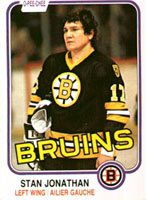
Stan Jonathan


To understand how Stan Jonathan inherited his second-to-none work ethic, you just have to look at his childhood.

Jonathan was raised as the sixth child in a family of 14 on the Six Nations' Reserve in Ontario. Life was hard although his dad - one of his biggest boosters - earned a good living on "the high steel". Stan himself actually worked on the high steel, as a rigger, building apartment and office towers in the U.S. and Canada. This of course was a very hazardous job.

"I did it for four summers from the time I was 16. I was scared the first couple of times I went up. But soon I learned it wasn't all that dangerous if you followed the safety precautions. But it's just like hockey: Get careless and you can get hurt," Stan said.


Stan worked hard, and always got the job done, whether it was at the construction site or on the ice. And he received high praise.

"Stanley reminded me of my pet dog, Blue, a bull terrier. They were both relatively small but enormously tough. I liked Stanley so much that I took a beautiful painting of Blue from home and had it hung directly above Jonathan's locker."

These words come from Don Cherry's autobiography "Grapes". And in the book he continues:


"One day Stanley's father was visiting Boston and was introduced to me in my office. 'You've got a great son  there, Mr. Jonathan,' I said. 'He reminds me of my dog, Blue.' Old man Jonathan was aghast. Comparing his son to a dog. Well, this big Indian stared at me until I thought I was going to get scalped. I had a lot of fast explaining there or I would have gone the way of General Custer. If I had had the time I would have explained to Mr. Jonathan that Blue was not only my pet, but also my alter-ego."

It's easy to understand Cherry's fondness for this little fireplug who some consider to be the best pound for pound fighter of all time. Just 5'8" 175lbs, this full-blooded Tuscarora Indian played the game like a human bowling ball. He loved to hit anything in sight and loved to get hit as well. Stan was a strong aggressive checker and a streaky scorer. He went after rebounds with reckless abandon. He wasn't fancy but he worked very hard and made things happen all the time when he was on the ice.


When Stan played junior hockey for the Peterborough Petes (QMJHL) between 1972-75 he showed a lot of scoring potential, collecting 176 pts (69 goals and 107 assists) in 204 games. Stan's big break came when Don Cherry and Bruins general manager Harry Sinden went to Oshawa late in 1975 to check up on Boston's No.1 draft pick Doug Halward. As it turned out Halward was injured in the game that they went to see. Instead, as the game progressed Cherry noticed a feisty little player named Stan Jonathan.

"I couldn't help noticing this rugged little Indian. He didn't play an exceptional game, but there was something about him that made me take notice," Cherry said, and continued. "I didn't say much about Jonathan to Harry, but I filed his name in the back of my mind for future reference and at draft time I called Harry aside and said: "Do you think you could get me one hockey player?"

"Harry was not as impressed as I was and bypassed Jonathan on the first, second, and third picks. We finally got him the fourth time (in the 5th round) around and sent him to Dayton Gems of IHL. A year later he made our team. Of all my discoveries, Jonathan is the one in which I take the most pride."

In Dayton (1975-76) Stan played for a $8,000 salary and did it very well. He led all playoff scorers with 13 goals and 21 points in 15 games. The following season Stan managed to crack the Bruins lineup and immediately became a crowd favorite in Boston. In his first NHL fight he completely destroyed Chicago's defenseman Keith Magnuson who was a big, willing 2nd tier fighter. Some of his other victims included Dave "The Hammer" Schultz and Andre "Moose" Dupont.

But Stan didn't just fight. In his first year he led the NHL in shooting percentage (23.9 %) as he scored an impressive 17 goals on 71 shots.

Late in his rookie season Stan was placed on Jean Ratelle's left flank. Ratelle, a future Hall of Famer, was a textbook player who used to feather his passes over to his wings.

"Who wouldn't want to play for a centerman like Jean Ratelle?," Stan said as a rookie. "Ratelle just has some fantastic moves. There's one Jean makes coming in on the defense. Really it puzzles the defenseman. If they move at him one way, he dumps a pass to me or to the right side. If the defense plays wide for the pass, well then Jean just keeps going in on the goalkeeper. Incredible!" Stan said admiringly.

In his sophomore season (1977-78) Stan had a 22.3 shooting % (among top 10 in NHL) scoring a career high 27 goals and 52 points in 68 games.

Stan is however mostly remembered for his classic and brutal fight on May 21, 1978. It was game 4 of the Stanley Cup final between Boston and their archrival Montreal. Right from the start of the game Canadiens coach Scotty Bowman wanted to deliver a "non-nonsense" message. So he sent out a bunch of big fellows: Pierre Bouchard (6'2", 205 Ibs), Gilles Lupien (6'6", 210 Ibs) and Rick Chartraw (6'2", 210 Ibs) among others. Cherry countered with Terry O'Reilly, John Wensink and Stan Jonathan.

At the 6 minute mark of the first period it was obvious that all hell would break lose. Stan and Pierre Bouchard were side by side. Stan gave Pierre a "gentle" shot. After that they dropped the gloves and started swinging. At the same time Lupien and Wensink squared off. At first it looked like the much bigger Bouchard was going to win the fight as he connected with the first blows. But Stan shook them off like water and took Bouchard's best shots without blinking. The guys traded punches at a tremendous pace. Stan who was leading with his right then suddenly switched to his left and caught Bouchard off guard. Stan carved into Bouchard's face with a series of lefts until the helpless Canadien crumpled to the ice, his nose and cheekbone    broken, his face a bloody mess. Bouchard's reputation and career was never the same after that brutal fight.

Stan's junior coach Roger Neilson was in the stands that night.

"Jonathan is a little like boxer Joe Frazier," Neilson said that night. "He'll take two punches to get in one of his own - and the one is a dandy."

Hall of Famer George Armstrong, also a Native Canadian, liked Jonathan.

"Hey, I've known Stanley and his folks for years. Stan will fight, yes, but he doesn't look for trouble. He won't back away when it comes, either. He's a good, tough hockey player. And he'll score his share of goals, too. Besides, you just can't beat us Indians."

It seemed that Stan thrived during the games against Montreal. In one of his finest efforts he scored a hat trick against Ken Dryden during game six of the 1979 semi-finals. Stan's fearless style of play gave him some injuries as well. In 1978-79 he missed 47 games due to a fractured wrist and shoulder injury.

Stan lasted six full seasons in Beantown before getting traded to Pittsburgh on November 8, 1982. He played 19 games for Pittsburgh and finished the rest of the season in Baltimore (AHL). Then in April 1983 the Penguins returned the rights to Boston. Stan never played for Boston again and opted to retire instead, only 28 years old.

Stan always thrived on hard work. Something he learned from an early age.

"With a family as large as mine, we had to have rules. And hard work was one of them. If you wanted something badly enough, you had to work for it," Stan said. He sure did, earning every minute of his playing time.

A player like Stan Jonathan today would have fan clubs and be one of the most popular players around. Enforcers today would swallow a lot of blood from the fists of this Tuscarora Indian.

July 23, 2015

Ramzi Abid

There have not been too many hockey players with Arabic roots. But one rare exception was Ramzi Abid.

"My dad was born in Tunisia and came over to Canada when he was 20 years old, and I was born and raised in Montreal.

Abid's 1999-2000 campaign was one for the ages. Not only did he score 57 goals and 80 assists in 59 regular season games with Halifax, but he led the Memorial Cup hosting team to an admirable performance in the high-profile tournament. The Mooseheads team captain was the top scorer in that year’s Memorial Cup tournament.

Abid was originally drafted 28th overall by the Colorado Avalanche in 1998, but having failed to sign his first pro contract with the team, he re-entered the draft in 2000. Despite his strong performance in Halifax that season, the Phoenix Coyotes found him with the 85th overall pick.

Abid would play in the minor leagues for the next three seasons, with the exception of a 30 game look with the Coyotes in 2002-03.

He was then acquired by the Pittsburgh Penguins at the 2003 trade deadline from the Coyotes along with Dan Focht and Guillaume Lefebvre in exchange for Jan Hrdina and Francois Leroux. He would spend parts of two seasons with the the Penguins, though a torn ACL injury kept him on the sidelines much of his time there.

In Phoenix Ramzi played for coach Wayne Gretzky. In Pittsburgh he skated with Mario Lemieux. Playing with those two all time greats ranks high as Abid's career highlights.

"I think that's pretty special. I had a chance to skate with Wayne and now I'm having to get a chance to play with Mario, especially on my line. Obviously, I feel special and it's an honor for me to play for these two guys."

Abid would go on to brief appearances in Atlanta and Nashville before an extended tour of Europe. He called Switzerland, Russia, Sweden, Germany, Austria and Finland home for a few seasons.

When asked to describe his game, Abid admitted he embraced "reckless abandon" as a style of play.

"That's my style. I have to work hard, play physical and my force is around the net and in the corners. I try to create room for my linemates and myself and I feel that this is a great situation for me."

Ramzi Abid played in 68 career NHL games, scoring 14 goals and 30 points.

Kyle Wanvig


Kyle Wanvig was a hulking winger out of Calgary, Alberta that the Minnesota Wild had high hopes for. He established a reputation in junior hockey with the Red Deer Rebels as a hard hitting, big bodied winger with good scoring instincts. He scored 55 goals in his last year of junior while helping the Rebels win the Memorial Cup. He was named as the Memorial Cup playoffs' MVP. In a word, he was dominating.

The Boston Bruins initially drafted Wanvig in the third round, 89th overall, in the 1999 draft. Unable to sign him, Wanvig re-entered the draft two years later where the Wild selected him in the second round, 36th overall.

Interestingly, the Wild were very lucky to get him. Before the draft the Bruins had agreed to trade Wanvig's rights to Toronto for Jonas Hoglund. The Leafs and Wanvig hastily agreed to a contract, but a jammed fax machine prevented the contract from reaching NHL offices by the deadline by mere minutes. When the contract did arrive it was ruled as too late, and the trade was rescinded.

Wanvig turned pro for the 2001-02 season, but a bad ankle injury, first suffered in the summer, devastated his season. Never a great skater to begin with, in terms of speed or agility, the ankle injury certainly had an effect on his early development as a pro.

Wanvig would apprentice in the minor leagues for four seasons (winning a Calder Cup championship in 2003) before making the Wild roster full time in the 2005-06 season. However with only four goals and twelve points on his record, he was quickly turning from prospect to suspect.

Through it all, Wanvig kept a great perspective.

"Basically for two seasons, I was last cut and it came down to waivers, I could clear and some guys couldn't or were on one-way contracts," he explained. "It's been a little bit of a longer road than I was expecting but maybe that's what I needed. Maybe for my development I had to go through some growing pains and injuries to get to where I am now.

In the summer of 2006 he signed with the Atlanta Thrashers organization, but never played for the NHL team. A few months later he was traded to Tampa Bay but, aside from a total of eleven games, he was mostly farmed out for two seasons.

''It is difficult for a player to break in with our club when he hasn't had a training camp with us, and clearly that impacted Kyle following the trade last season. With the chance to get to know our organization and our system, as well as the opportunity to get himself in the best physical shape of his career this summer, we expect Kyle to come to camp looking to earn a spot on our roster," reasoned Tampa manager Jay Feaster.

Wanvig extended his hockey career with a four year tour of Europe, stopping in Russia, Sweden, Germany, Slovakia and Austria. He admitted the bigger ice and less aggressive nature of the European was a tough adjustment, but he relished his experiences overseas.

Andrei Zyuzin


Time and time again teams gave him a chance, despite his lack of physical play and lack of production. His superior skating and offensive instincts teased of a player like Brian Leetch, though he lacked the lateral movement along the blue line to truly put up great numbers. But he could rush the puck out of his own zone like few others.

Whether at top speed or while quarterbacking the power play, Zyuzin was a smart playmaker. He had a strong shot and, unlike many European defensemen even at that time, was not afraid to use it.

Yet he was always an awkward at every NHL stop. Despite good size he was not a physical player in any regard. But even at an early age he was not a defensive liability. If his team needed a goal he would turn on the jets and press for the extra offense. Otherwise he would stay back and play solid positionally and let his superior anticipation help him defend.

Despite that impressive breakdown of his ability, Andrei Zyuzin only scored 38 goals and 120 points in 496 regular season contests. His best season - 2003-04 with Minnesota - saw him set career highs with just 8 goals and 21 points.

Despite never putting up offensive statistics that rivaled his immense potential, Andrei Zyuzin was always labelled as an offensive defenseman.

The rushin' Russian was drafted 2nd overall by the San Jose Sharks in the weak 1996 NHL Draft.

"A young kid with that kind of ability, he's going to play in this league a long time," said Sharks coach Darryl Sutter.

Sutter would soon learn the ability was apparent but frustrating, as Zyuzin "had all the tools but not the tool box," as Harry Neale used to say. Sutter would mercilessly ride Zyuzin, destroying the young player's confidence and leading to a fractured relationship.

That fractured relationship extended to off the ice, too. In his sophomore year he bizarrely went AWOL on the Sharks. He packed up and went back to Russia, missing 12 games. This followed an earlier incident where he refused to report to the minor leagues.

He did return and all parties involved publicly said all the right things about no hard feelings. But the Sharks traded him to Tampa Bay in the summer.

Zyuzin welcomed the change in scenery but a shoulder injury cost him half of the 1999-2000 season. He never would get a full season in with the Lightning.

From there it was off to New Jersey and Minnesota, two unlikely fits given their defense-first systems. His best fit was probably with the Wild. After being a healthy scratch numerous times when he first arrived, he emerged as a regular for a short time.

He also would play briefly with Calgary and Chicago.

All in all Andrei Zyuzin earned a reputation as a solid if teasing NHL defenseman who just never quite seemed to find the right spot.

Adam Graves

In an era when the NHL was being dominated by hockey's version of globalization, Adam Graves was the traditional Canadian hockey player.

"He's very physical, he will do anything to get his team geared up," said one NHL coach "He plays the game every inch of that ice. He wants to command, and he commands a lot of respect out there. He's a total player. He's a spark. He's an inspiration. There's an m.v.p. guy, let me tell you. He's just an outstanding player and an outstanding person."

"Adam was always the type of kid you wanted to make it," Colin Campbell, his former coach said. "He is conscientious, nice, hard-working, respectful. And usually those guys don't make it. Adam is the milk-drinker who goes through hell for you."

He plays a rugged, aggressive game of hockey, with a mean streak that enhances his talent and inspires his teammates. He parks his often bruised body in front of the net, especially playing on the power play. Graves is a willing fighter, often known as Mark Messier's bodyguard, both in Edmonton and later New York. Kevin Lowe, team-mate of both in both cities, calls Graves "the sheriff" for his willingness to defend fellow Rangers.

Graves was drafted by the Detroit Red Wings out of the Windsor Spitfires of the OHL. He finished the 1988 season with the Wings after leading the Spitfires to the OHL championship. He split the 1988-89 season with the Wings and their AHL affiliate. He was quickly traded in the beginning of the 1989-90 season in a huge trade. Graves, Petr Klima, Joe Murphy and Jeff Sharples were all moved to Edmonton in exchange for Michigan-born Jimmy Carson and long time Oiler tough guy Kevin McClelland.

Graves filled a similar role to McClelland while in Edmonton, but possessed much promise which never really was tapped in the City of Champions. He played 2 seasons with the Oil, scoring 15 goals in 139 games. He teamed with Martin Gelinas and Joe Murphy to form the Oilers version of the "Kid Line." The trio combined speed and youthful enthusiasm in a supporting role in the Oilers 1990 Stanley Cup Championship.

The New York Rangers plucked Graves away from Edmonton in 1991 via the free agency market. It was in New York that Graves blossomed into a star. He blossomed in 1991-92 to score 26 goals, more than doubling his career total. The next year he improved to 36 goals and by 1993-94 he joined Vic Hadfield as only the second New York Ranger in history to score 50 goals. In fact Graves' 52 goals better Hadfield's then-team record by 2. Graves of course would add 10 goals and 17 points in 23 playoff games to help bring Lord Stanley's Cup back to Broadway for the first time since 1940.

Graves would have trouble reaching the same plateau again. Playing in pain but rarely missing a game, he became a consistent 20 goal scorer in the years following.

Though not known for using a stick in flagrant ways, one of Graves' most infamous moments involved a stick foul against the Pittsburgh Penguins' star Mario Lemieux in the 1992 playoffs.While killing a Pittsburgh power play, Graves swung his stick and broke a bone in Lemieux's right hand, putting him out of the series. Graves received a suspension that kept him off the ice for the rest of that series, and the Rangers, regular-season champions then, as they are now, were eliminated by the Penguins.

Gravy is also one of the NHL's nicest guys. The 1994 King Clancy Memorial winner, Graves participated in many activities involving under privileged kids in New York.