August 23, 2011

Gone Fishing! (actually, hiking)

The picture above is of Rocket Richard enjoying the only passion he treasured more than hockey - fishing.

Accompanied in this image by Butch Bouchard, the photo is part of a Charles Wilkins snapshot of the Rocket in the May 2006 edition of Outdoor Canada magazine. The article gives a great insight into Maurice Richard the man, not the hockey player, and his other passion. His love of fishing many times exceeded his love of hockey. At his funeral the Cardinal Jean-Claude Turcotte's final good bye was "Maurice Richard enjoyed fishing. So I think he won't be bored very long in heaven because Jesus' disciples were also fishermen. I can imagine Maurice fishing with them, and having lots to talk about. Good fishing, Maurice."

I tried finding an online link to the Outdoor Magazine article, but I had no luck. I was able to find Outdoor Canada archived articles on the fishing adventures of Mike Richards, Kris King, Brendan Morrison, Johnny Bower, and most notably Bill Barilko. The legend of Bill Barilko grew on his final fishing trip. His plane would disappear and mystery would ensue.

I am sure a lot of NHLers nowadays spend a lot of their summer time off fishing. I know quite a few of the NHL general managers head up my way en route to Langara Lodge on Haida Gwaii.

Old time hockey players never had all summer to fish or golf or vacation. No, many of them had to work regular jobs to keep the family household afloat. Here's just a few examples I could think of off of the top of my head:
  • Gordie Howe worked at a golf course
  • Johnny Bower operated "Bower's Big Boy" restaurant.
  • Alf Pike was a licensed mortician.
  • Glen Harmon worked in his wife's hat store.
  • Butch Bouchard was a bee keeper and honey farmer.
  • Phil Esposito - worked on construction site.
What are some of the more interesting summer jobs held by NHL players that you know of?

Speaking of fishing and summer, GreatestHockeyLegends.com and HockeyBookReviews.com will both be pretty quiet for the next few weeks as I go on vacation. I won't be fishing so much as hiking and later city exploring (I've got my Nordiques jersey ready for Quebec City!)

Any updates during this time will be sporadic, but there is no shortage of pieces to read here in the mean time.

For new and regular readers alike this is a great time to explore the more than 1800 players profiles and the deep archive of feature stories I've written over the past few seasons. It is also a great time to look ahead at the coming 2011 class of hockey books.

You can also follow me on Twitter @HockeyLegends or on Facebook.

Greatest Hockey Legends: The E-Book


As the hockey season gets closer, I will be releasing my first e-book. This will be my third book, as I previously released World Cup of Hockey: A History of Hockey's Greatest Tournament (with the incomparable Patrick Houda) and The Legends of Team Canada to store bookshelves via Warwick Publishing..

Other than to say it will be a collection of stories with as much of a personal touch as possible, I will be releasing more information about my e-book as the season nears. I have not settled on a title just yet, but project is something along the lines of James Duthie meets Jack Falla.

Since this is my first e-book, I wanted to play with the software to familiarize myself with the process. As such, I have released a small e-book Greatest Hockey Legends of the Winnipeg Jets simply for practice purposes.

It is a small project, and really is nothing like my main e-book I will be releasing later. I will leave the Jets e-book available for now, at the bargain basement price of $0.99. I would consider any purchase of the book as essentially a donation, but also an opportunity for feedback. Let me know what you think, what you like and what you don't like. Do you have any experience or advice with e-books, either as a user or a consumer?

To view the e-book you will need a Kindle or the Kindle App for your iPad/iPhone/iPod or whichever device you do use. I look forward to getting some feedback.

August 22, 2011

The Mystery Behind Ed Kea's Death

In the aftermath of the deaths of Derek Boogaard and Rick Rypien, The National Post's Dave Bidini wrote an equally fascinating but uncomfortable article about youth hockey's subculture.

Realistically this article should be inclusive of all sports in North America. I also found Bidini guilty at times of stretching his arguments to some degree. Mr. Rypien's family history of mental illness has been brought to light, suggesting he may have been pre-disposed to his demons regardless if he ever played hockey or not.

But ultimately Bidini's argument is correct - that sometimes the environment of youth sports - created by both teammates and adult coaches - is not a good place for our children to be around. Even if it is disturbing read, it is an excellent read. Hopefully it brings to light the need for these leagues and national bodies to clean this up.

In concluding the article Bidini made note of a another NHL death which he, apparently intentionally, may have altered history.

He talks about Ed Kea, a NHL defenseman with the Atlanta Flames and St. Louis Blues in the 1970s and early 1980s. If he is known at all to new generations of hockey fans it is as Joe Nieuwendyk's uncle. His career ended after a major concussion, which Bidini (in another stretch) ultimately killed him.

In 1999 Kea died prematurely at the age of 51. It has always been reported, including in obituaries at the time, as an accidental drowning.

However Mr. Bidini suggests otherwise:

"Here's a story, and I'm telling it: It's about an old player from the '70s, Ed Kea, a former Atlanta Flame who hated what he'd become. Because of undiagnosed concussions and other injuries, he could barely walk or understand what his wife was saying. So, one day, Ed wheeled himself to the edge of the dock and threw himself into the water. His wife looked out the window of their home - she was going to bring him tea, maybe a sandwich - but the dock was empty. He was gone. Gone. The game had stolen him, taken from his family, but some would suggest that he'd disappeared long before he'd taken his life."

Is Bidini letting the real story of Mr. Kea's death out of the bag?

Update: Here is Bidini's response to my question, via Twitter.

@hockeyesque - his nephew told me this last year

He has not yet answered why the family has always kept this news quiet over the years, or if the family has given it's okay to let this news be known at this time.

August 18, 2011

New Biographies Added

Through-out the playoffs I really got away from publishing career biographies of former NHL players. And since the season ended I have purposely stepped away from hockey quite a bit this summer. It is something I definitely felt I needed to do, and due to upcoming vacation time, I will continue to do until the puck drops on the new season.

That archive is the absolute heart of GreatestHockeyLegends.com. I recently have added several new biographies, and will return in earnest to doing so soon.

The newest biographies of former NHLers featured are Patrick Lalime, Jimmy Waite, Lee Sweatt, Kris Draper, Mark Kirton, Don Jackson, Risto Siltanen, Corrado Micalef, Peter McNab, Dave Pichette, Valeri Zelepukin, Jay Wells, Sylvain Cote, Mark Hamway, Roger Kortko, Dmitry Yuskevich and (unfortunately) Rick Rypien.

August 15, 2011

Rick Rypien Passes Away


Stunning news this week as NHL tough guy Rick Rypien was found dead. The 27 year old NHL tough guy was known for his countless battles on the ice. Rumors had always swirled but none of us ever knew just how serious his battles were off the ice, too

Rypien was a popular NHL tough guy, taking on fighters much bigger than himself. Twice, including most of the past season, he took lengthy leaves of absence due to personal issues. Though the team or player ever admitted what the issues were, rumors had always swirled he was suffering from a mental illness.

Globe and Mail reporter James Mirtle confirmed Rypien had been battling depression for years. Mirtle also found out that the illness runs deep in the family.

Ultimately Rypien's greatest battle was one he could not win. He ended his life on August 15th, 2011. He was just 27 years old.

He may have signed with the Winnipeg Jets, but Rick Rypien was a Vancouver Canuck through and through. The son of a former Canadian boxing champion was pound for pound as tough as any fighter in the league. He often gave up a lot of pounds, and inches in height and reach, as most of the NHL heavyweights were much bigger than he was. But he took them on anyways, using rapid fire punches with both hands. He was very good at blocking punches, which, surprisingly, is not something all hockey tough guys do.

In doing so he became one of the most popular tough guys in Canucks history, ranking up there with Tiger Williams and Gino Odjick. Had he not missed so much time with injuries and personal issues, Rypien almost certainly would have rivaled those two in all-time popularity, too.

We saw it first hand here in Terrace, a.k. a. Hockeyville 2009. The Canucks and New York Islanders came to northwestern British Columbia even if most of the stars did not. Willie Mitchell and Kevin Bieksa appeased the fans, as did Ron MacLean and Don Cherry. Curious eyes watched youngsters like Cory Schneider and Michael Grabner. Sergei Shirokov stole the show with both goals in a 2-1 victory.

But it was Rick Rypien who was the fan favorite in the blue-collar town. He fought twice, including slaying big Andy Sutton who absolutely towered over him. Like I did so often when "Rip" took on the giants, I genuinely feared for him. But in usual rapid style fashion, Rypien unleashed fists of fury early on and held his own. The crowd of 1000 roared as loudly as any sell-out crowd at Roger's Arena.

First and foremost Rypien was a fan favorite. #37 t-shirts and jerseys were as common in Vancouver as the Sedin twins or Roberto Luongo. He was a great fighter, despite his lack of size. He was full of guts and gusto. I genuinely believe had he been healthy enough to play full time he would have been an effective role player beyond fighting. He had good wheels and decent hands, once in a while surprising with a laser shot or smart pass. He hit hard on the forecheck, though could get lost on his defensive assignments.

Rick Rypien's death will leave many questions. Did the Canucks and the NHL do enough to help this man? Did Rypien himself seek enough help on his own? Is there any correlation between his troubles and fighting in hockey? On the surface these answers seem obvious, but these are uncomfortable questions that need to be examined.

Depression and mental illness is not something most of us can not really understand. The NHL and the Canucks in particular have a great opportunity to turn this tragedy into a campaign of awareness to help eliminate the stigma of mental illness. Hopefully they make this opportunity into their responsibility.

August 14, 2011

The Littlest Hulk


When the Edmonton Oilers entered the NHL in 1979, they embraced players from Finland more so than other organizations. They had great success with Jari Kurri, and also with the likes of Matti Hagman and Risto Siltanen.

The St. Louis Blues actually drafted Siltanen in 1978, but he remained in Finland until joining the WHA Edmonton Oilers later in the year. The Blues retained his NHL rights upon the Oilers merger with the NHL, but traded him to Edmonton before the season started. Siltanen was in the lineup for the Oilers first ever NHL game.

In the Oilers early days prior to Paul Coffey's emergence, it was Siltanen who assumed the offensive dman's role. One of the earlier European imports, Risto Siltanen was a very good offensive presence from the blue line. He was an excellent skater both in terms of speed and agility. He liked to rush the puck out of the zone, as his passing game was only average. He was a terrific stickhandler, though he could be pressured into holding the puck longer than he should have. He was reluctant to give up or dump the puck out of his zone without making a play.

Here's the full Risto Siltanen biography.

August 12, 2011

Jimmy Waite Retires

Jimmy Waite has retired. Did you even know he was still playing? He has spent the past 9 seasons in Germany.

Here's more from the Twitterverse:

Jimmy Waite, one of the great Canadian World U20 goalie heroes, retires at age 42, after 9 seasons in German league. Won U20 gold 1988. - @Sz1909_Szemberg

Waite, once a 1-rounder for CHI, has had a remarkable career although never cut it in NHL. Will become asst. coach in Chicoutimi in the Q. - @Sz1909_Szemberg

IMO, Waite played the greatest single game for Canada in the WJC. Outshot 40-16 by Russia in '88, Canada won 3-2 in Moscow and won gold. - @GMillerTSN

Waite will always be remembered for his time with Team Canada at the World Junior Championships. In 1987 he was part of that infamous team that was kicked out for brawling with the Soviets. But in 1988 he played a major role in Canada knocking off the Russians to win gold. He was named as the tournament's top goaltender, shutting down the high flying Alexander Mogilny and Sergei Fedorov.

It was the highlight of a brilliant junior hockey career that had him rated as a top NHL goaltending prospect. However I always recall one anonymous scout warning readers in The Hockey News annual 1987 draft preview that Waite would not make it in the NHL. It turns out he was right.

He called it a weak year for goaltenders, with Rick Tabaracci and Jeff Hackett as the top goalies. But the Chicago Blackhawks disagreed, drafted Waite 8th overall in 1987. By the time he was ready for the NHL the Hawks already boasted Ed Belfour and Dominik Hasek in net. Waite was so highly regarded that the Hawks moved Hasek out of town.

The older Hasek was still unproven in the NHL, but of course would blossom into one of the NHL's all time greats in Buffalo. Waite never did find a home in the NHL.

Waite struggled mightily in Chicago. In his first season he played in 11 games, posting a disastrous 0-7-1 record with a 5.22 GAA. He would spend much of the rest of the decade jumping between the Hawks and their farm team, coming up for sporadic games. He seemed to have cemented the backup job in 1991-92 and 1992-93, playing in a total of 37 contests, but it did not last. It certainly did not help that Ed Belfour was so good and such a workhorse.

Waite would go on to cups of coffee in San Jose and Phoenix before disappearing to Germany for decade.

All told, Jimmy Waite played in 106 NHL games, winning 28, losing 41 and tying 12. He had 4 shutouts.

Lee Sweatt Retires


As far as NHL fans are concerned, Lee Sweatt came out of nowhere, scored a beautiful goal, broke his foot and retired. 

It turns out the story of Lee Sweatt is a far more interesting one that. He is a player and a person I have a lot of respect for. Here is Lee Sweatt's career biography.

August 09, 2011

"The end analysis was, I was not Wayne Gretzky"

For a city that often barely recognizes either of the two NHL teams located there, the Los Angeles Times has a nice story on former King Jimmy Carson.

Many people forget about Carson's first three years in the league, especially his first two in Los Angeles where he and fellow newcomer Luc Robitaille breathed new life into a long-sagging organization.

For two seasons together, Robitaille and Carson prospered, Robitaille exceeding expectations and Carson, a goal-oriented son of a lawyer from well-to-do Grosse Pointe Woods, Mich., more than living up to his advance billing.

Robitaille won the Calder Trophy as the NHL's rookie of the year in 1987, Carson joining him on the all-rookie team. The next season, Carson scored 55 goals to give him 92 before his 20th birthday, more than any other player in NHL history.

But then came Aug. 9, 1988, when everything changed.
Carson, who had just signed a new, multiyear contract and bought a house in Redondo Beach, was traded to the Edmonton Oilers in the blockbuster, multiplayer trade that brought hockey icon Wayne Gretzky to the Kings.

He didn't know it then, but his most enjoyable seasons were behind him.
He had just turned 20.

Carson was not bad in Edmonton — he rang up 49 goals and 51 assists in his first season with the Oilers — but he was not great. Nor was he, as seemed to be constantly noted, The Great One.

"The end analysis was, I was not Wayne Gretzky," he says.

After his season in Edmonton, Carson moved to his hometown of Detroit and struggled, then bounced around the league for 3 years before simply vanishing. People questioned his heart, making this Bruce McNall quote from the LA Times piece all the more interesting.
"In a weird way, I knew Jimmy's heart was not as much into it," says McNall of his friend, who neither smoked, drank nor partied with teammates. "He was an intellectual, multidimensional guy, read the Wall Street Journal, and so many other players just don't have his opportunities and interests. So I always thought, deep down, that maybe long-term hockey wouldn't be for him."
There is much more to this worth-reading LA Times piece, and I encourage you to do so.

August 08, 2011

John Kordic: Fists Of Fury

It was on this date in 1992 that the hockey world was shocked by the death of one of it's own: the troubled and troublesome John Kordic

I recently met a close personal friend of Kordic. She wanted everyone to know that he was not the monster he was known for on the ice and in the headlines. He was "very funny... sometimes annoyingly so lol and had a good heart, way smarter than he looked too!"

However soon alcohol and substance abuse would take over Kordic's life.

"He was so torn up and lost after his father's death, as you mentioned. That's when he really unraveled," she added.

Like any true friend, she will not remember him for the bad times, but rather the good times.

"I adored the kid who didn't use drugs and loved to play hockey and tell stupid jokes and dream of being a professional wrestler after hockey which would have been perfect for him!! Getting paid to fight without the penalties!"

Here's more on the troubled and tormented life of John Kordic.

August 04, 2011

Scotiabank's NHLPA Mailbag


Scotia Hockey Club has teamed up with the NHLPA to create the Scotiabank NHLPA Mailbag.

This season hockey fans will be able to interact with NHL players on Facebook. Post your questions to each week's participating NHL player, and he will answer selected questions.

This summer Jarome Iginla is already answering selected questions.

Scotia Hockey has been kind enough to give me 10 hockey tshirt gift packs to give away. Simply join me on Twitter @HockeyLegends and tell me which players you'd like to see participate in the Mailbag feature this season, and what questions you'd ask them.

Summer Reading: King of Russia

My latest summer 2011 campfire read is McClelland and Stewart's 2007 release King of Russia: a Year in the Russian Super League. It chronicles Canadian hockey coaching legend Dave King's journey to the Ural Mountains to become the first Canadian coach in Russia. The book is based on King's daily diary, typically meticulous and refreshingly open, and polished up beautifully by The Globe and Mail's ace hockey reporter Eric Duhatschek.

Buy the Book: Amazon.ca - Chapters - Amazon.com
 

I personally consider Duhatschek to be the best hockey journalist out there for quite some time. Not only is he incredibly connected, thorough and respected, but he's got an easy to read and captivating writing style. So I guess I shouldn't have been so surprised how easily I was drawn into the text.

But I was very pleasantly surprised just how compelling and fascinating the text is. One biography or well written autobiography that I've always wanted to read is that of Coach King. He is a three time Olympic coach, and formerly the one man Canadian national team king-pin. He's also coached two NHL teams and teams all over the world. As one of the greatest - although also greatly underrated - bench tacticians ever, his story potentially has so much to offer a reader - about the Soviets, about the NHL, about Canadian hockey and about European hockey, and so much more.

King of Russia isn't that book. Instead is a look into a single season of King's career. I cracked the spine already disappointed because I knew it wasn't what I was looking for.

A few paragraphs later, I realized I had found quite possibly the leading candidate for best read of the new hockey book season.

Back when King was coaching in Calgary, the NHL had a great influx of eastern Europeans. One of them was Soviet great Sergei Makarov. We North Americans were never truly understanding of the hardships these guys faced. A whole new country, a whole new way of hockey, a whole new language, a whole new life. They understandably struggled, and we were quick to dismiss them as inferior, and never truly understood the incredible transition they had to go through.

Well now we can, but in reverse. It is the Canadian, King, pioneering his way into Russia. He had to deal with the strange new homeland, a language barrier, a cultural 180 degree turn and a stubborn and peculiar hockey system. Oh, and there's such 21st century hazards such as the Russian mafia. Finally Coach King understands Makarov's struggles all too well.

Through it all, King tries to finds the silver linings, but in his daily diary he is very open about wondering if he has made a big mistake. At times we get to see the rare vulnerable side of a hockey legend.

But we also get to see so much more. By the end of the book, I'm converted in to a Metallurg Magnitogorsk fan and am looking online to buy a jersey. I feel for many of the players, much like King. King looks to former NHLer Dimitri Yuskevich defenseman to be an early pillar, and an English ally. Swedish defenseman Anders Eriksson and Canadian goalie Travis Scott are also relied on heavily. Ilja Vorobiev becomes a favorite of Coach King and of any Canadian reader. Others on the team include gormer NHLer Igor Korolev, the wildly enigmatic Stanislav Chistov and teenage phenom Evgeni Malkin, who leads the team and the league, but will soon leave the league to join the National Hockey League.

Malkin's departure allows to better appreciate how the Russians feel about the NHL continually uprooting the country's top young players. It's a real eye opener for us Westerners, and maybe the Russians have a point when it comes to their continuing dispute about player compensation with the NHL-IIHF player transfer agreement.

King learns first hand why the Russians are able to develop incredible individual talents but poor international teams. Its a far cry from their glory days, that's for sure.

Through it all, King is continually open and perplexed, and as usual successful. Its an amazing look into just one year of an amazing life. I still want a great biography or autobiography of Dave King, but I now realize it would take volumes to cover his hockey insight.

August 03, 2011

Bobby Orr Racing Donkeys

The other day we took a look back at Bobby Orr's annual sports camp he used to hold in Orillia, Ontario.

Long time GHL friend Dennis Kane spent his youth in that area, and he adds to the story, including photos of Bobby Orr racing donkeys!

August 01, 2011

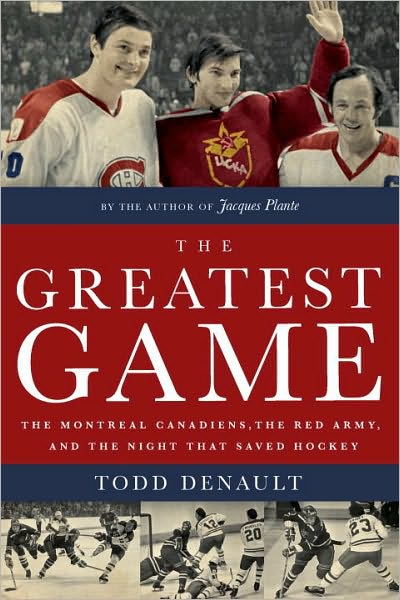
Summer Reading: The Greatest Game

Every summer I escape hockey and the computer by going camping and hiking. The escape from hockey is never far for me. I always carry a few hockey books for evenings of sitting around the camp fire. It is a great way to forget about the daily aches and blisters acquired while chasing waterfalls and mountain tops.

On my most recent outing I found myself staying up far later than I should have. I needed the rest for a full next day of outdoor activity, but I was far too immersed in Todd Denault's The Greatest Game.

Buy The Book: Amazon.ca - Chapters - Amazon.com - E-Book

The book is about the famous New Year's Eve clash between the Montreal Canadiens and the Soviet Red Army team back in 1975. My favorite parts of the book are the historical build up to the game. Denault explores the rise of the likes of Anatoli Tarasov, Sam Pollock, Ken Dryden and Vladislav Tretiak. It is a must read text for any fan of the Habs or the Soviets.

Denault is as thorough a hockey researcher as you will find, yet he presents his findings with the gift of a storyteller. It is a magnificent book. Here is my original book review.

The book is being released in paperback
in the fall of 2011. As soon as I found out about additional material I will pass it along.

  © Blogger templates Newspaper III by Ourblogtemplates.com 2008

Back to TOP